
Water Needs Haven't Shrunk: Uncommitted SRF Dollars Reflect Implementation Challenges
Recent comments from EPA officials have reignited a familiar debate about water infrastructure funding. In defending proposed reductions to federal water infrastructure programs, EPA leadership pointed to roughly $14.8 billion in “uncommitted” State Revolving Fund (SRF) dollars and questioned whether states are moving funds into projects quickly enough.
Uncommitted balances deserve scrutiny. Every uncommitted dollar represents a delayed opportunity to improve public health, replace aging infrastructure, remove lead service lines, or address emerging contaminants. But uncommitted funding is not the same thing as unnecessary funding. Before using a single national figure to justify deep funding cuts, it is worth asking a more important question: why do funds remain uncommitted in the first place?
EPIC has examined SRFs for years. In our 2022 report, Uncommitted State Revolving Funds, we analyzed why some SRF dollars remain uncommitted and identified practical strategies to improve performance. EPA refers to funds states allocate to a project as “committed.” Uncommitted funds are the difference between the available and committed funding. Our conclusion in the earlier report—and now—is that uncommitted balances deserve attention because they represent delayed opportunities to improve public health, water quality, and infrastructure. But understanding why funds remain uncommitted matters. The solution is to address the causes of delay, not assume the funding is unnecessary.
What Do We Mean by “Uncommitted Funds”
EPA has not explained how it arrived at the $14.8 billion figure. However, if it includes work that’s in progress as “uncommitted”—in other words, unliquidated obligations—compared against project amounts reported in EPA's tracking systems, that figure should be interpreted cautiously, for the reasons below.
When looking at this issue, state Intended Use Plans (IUPs), which report “uncommitted funds,” are a snapshot in time. A lag always exists between when funds are allotted to states, when a state enters a finalized funding agreement with an applicant, and when a project appears in EPA reporting systems (see EPIC's Following the Money report). States must complete project prioritization, environmental review, engineering, financial review, and other readiness-to-proceed requirements before awards are finalized and projects move forward. Through our own technical assistance program, as well as direct feedback from water utilities, we know it can take 12–18 months to move from application to the finalization of a financing agreement.
Why Some Funds Remain Uncommitted
Our earlier and ongoing research also finds that SRF performance varies across states. Some states consistently commit nearly all available funding, while others face administrative, staffing, technical assistance, or demand-related challenges. This variation suggests the issue is not the SRF model itself, but differences in implementation and capacity. States that utilize set-asides and invest in technical assistance, have adequate staffing, promote streamlined application processes, and provide proactive community outreach tend to move funding more quickly.
The current discussion also appears to overlook the unique challenges associated with implementing Infrastructure Investment and Jobs Act (IIJA) funding. States were required to establish entirely new programs for lead service line replacement and emerging contaminants, build project pipelines, interpret new federal guidance, comply with Build America, Buy America requirements, and, in some cases, address state legal barriers before funding could move forward. Our Drinking Water SRF Funding Tracker confirms that some states have struggled to move funds into projects, particularly within the new lead service line replacement and emerging contaminants funding streams.
Sometimes, state laws must be addressed before funding can move. In Tennessee, legislators recently created an exception for private-side lead service line replacement from a state law prohibiting the use of utility funds for “projects with a private purpose.” Before this change, water utilities were reluctant to pursue IIJA lead service line replacement funding. While the legal barrier slowed implementation, it did not reflect a lack of need. In fact, the opportunity to use IIJA funding to remove lead pipes and protect public health motivated state lawmakers to vote unanimously to remove the obstacle, creating the conditions for a stronger project pipeline moving forward.
These implementation challenges are not unique to a handful of states. EPA's own 2024 review of state SRF plans found wide variation in how states build project pipelines, provide pre-development funding, support disadvantaged communities, and structure application processes. States that invest in project development, technical assistance, streamlined applications, and proactive outreach tend to be better positioned to move funding into projects.
While some states were slow to ramp up, there are growing signs that many are catching up as barriers are resolved, applications increase, and programs mature. At the same time, states vary in how they report uncommitted funds—and some do not report them at all—making it difficult to draw broad conclusions about the scope of the issue from a single national figure.
Uncommitted Funds Do Not Mean Needs Have Disappeared
It is also important to distinguish between “uncommitted funds” and a lack of need. We continue to see substantial demand for drinking water, wastewater, and stormwater infrastructure, lead service line replacement, and emerging contaminants projects. In many states—Texas, for example—demand for SRF assistance exceeds available funding, forcing communities to compete for limited resources.
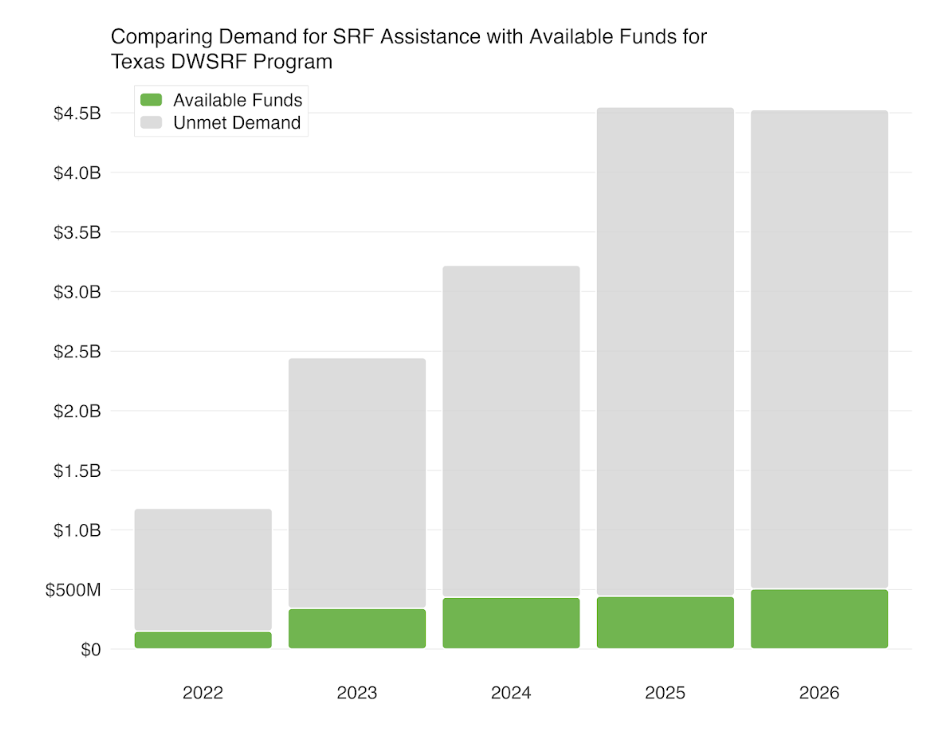
In many states, the challenge is not a lack of projects. It is the capacity and systems needed to move funding from appropriation to projects.
Large uncommitted SRF balances can reflect:
Accounting schedules not matching up with multi-year project development timelines.
Communities struggling to meet readiness to proceed requirements, such as completing environmental reviews and securing necessary permits.
Build America, Buy America, and Disadvantaged Business Enterprise compliance requirements limiting the pool of qualified contractors able to manage reporting and create administrative burdens for utility staff, which may discourage some utilities from pursuing SRF funding.
State agencies facing staffing shortages and capacity constraints. Our 2022 research found that states with greater staff capacity to recruit applicants and manage loans generally had fewer uncommitted funds and higher levels of SRF utilization.
Demand for technical, engineering, and construction services increasing following the influx of IIJA funding.
States needing time to build out new project pipelines for lead service line replacement and emerging contaminants programs.
Notably, EPA's Office of Inspector General (OIG)’s May 2026 report identified many of these same factors, including program staffing, capacity, guidance, and implementation challenges, as key barriers affecting the pace of deployment. The OIG report suggests that implementation delays are not solely attributable to states.
The Solution Is Better Implementation, Not Less Funding
A meaningful assessment would examine how funds are moving now that lead service line replacement and emerging contaminants programs are established, and states have resolved many early implementation barriers. Cutting funding after states have made those investments and built those programs would undermine progress rather than accelerate it.
The question is not whether SRFs can perform better. They can, and they should. States, EPA, utilities, technical assistance providers, advocates, and policymakers all have a role in reducing barriers and accelerating deployment.
But the existence of implementation challenges is not evidence that funding is unnecessary. In fact, it points to the opposite conclusion. The EPA’s Clean Watershed Needs Survey and Drinking Water Infrastructure Needs Survey and Assessment estimate more than $1.2 trillion in water infrastructure needs nationwide. That translates into substantial demand for financing assistance in many states. The challenge is not a shortage of projects. It is whether we have the systems, staffing, technical assistance, and project pipelines necessary to turn appropriated dollars into completed infrastructure.
Making the SRFs work better does not require making them smaller.