
WOTUS Scenarios Dashboard: Estimated Changes to Freshwater Wetland Permitting, Jobs, and Flood Protection
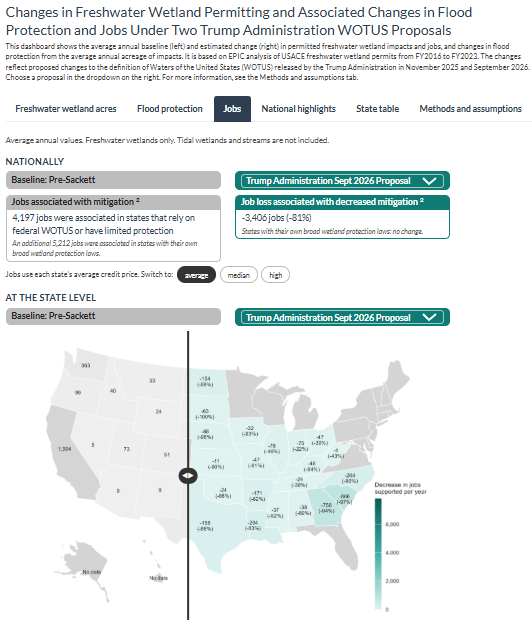
I gave myself eight hours to figure out the consequences of the September 2026 supplemental proposal to change the definition of waters of the United States (WOTUS). OK, so it took a lot longer than that and was built upon a lot of hard work that others have done before me (tagged below). But last Monday I put in the time and figured out, yes, this can be done. We had the receipts, I just needed to put them together to answer the question.
And here's the answer: the changes proposed are significant. Maybe you’ve already seen this in research that looked at the landscape. We looked at permits instead. To be more specific, US Army Corps of Engineers data on Clean Water Act Section 404 permits for impacts to freshwater wetlands (we didn’t look at streams, but others have). These permits predated the Sackett decision and the two most recent proposed changes. Then we applied proxy thresholds for the proposed definitions (Nov 2025, Sept 2026), in states with limited or no state-level protection to fill in the gap left by the feds.
The September 2026 proposal in particular reduced federal protection to the bare minimum. Under that proposal, 84% of the permitted impacts to freshwater wetlands, by acreage, would no longer need a permit.
Yes, states can pick up the slack. But that takes time, money, and effort. There could be a lot of downstream impacts in the meantime.
We just published a dashboard that shows what the proposals mean for:
Acres of freshwater wetland impacts: 3,000+ acres/yr would no longer need a permit
Jobs tied to compensatory mitigation that used to go along with those permits: potential loss of 3,400+ jobs
Increased flood damages / insurance payouts associated with losing wetlands: 8M-$27M of flood protection lost over 50 years from just one year of impacts that no longer need permitting
Comments on the proposal close on October 9th 2026 at 11:59pm EST (see EPIC’s comment letter).
Like I said, I also have “the receipts” - an overwhelming, mad scientist spreadsheet with all of the data and assumptions behind the dashboard, plus the option to change those assumptions (“Choose your own WOTUS adventure!”). It’s not quite ready for publication but reach out if you’d like a copy. For now, you can check out the Methods and assumptions tab in the dashboard.
Thank you to the people whose work this builds on: Dr. Chris Samoray (UNC-Chapel Hill), who developed the permit-based method; Dr. Todd BenDor and colleagues, who developed the jobs multipliers; Dr. Adam Gold, whose research informed the methodology on the proxy for which wetlands keep protection; Dr. Jesse Gourevitch, Dr. Adam Gold, and Helena Garcia, whose Nature Water paper provided the flood loss values; and Dr. Charles Taylor and Hannah Druckenmiller, the OGs of wetlands and flood insurance $$. There are other great studies out there too.
Finally, I have a wishlist for additional research that I’d love to do - consider supporting us to make my data nerd dreams come true.
Wishlist:
A better way of pinning the impact acres no longer needing permitting to HUC12 for more refined flood damage values. I have the hunch that more permits are located in metropolitan areas, where flood damage values may be higher
Adding stream impacts no longer needing mitigation. This is a pretty big lift (speaking for myself) but there are others who have made in-roads that this could build upon.
If I can find it, overlaying point source discharge permits on streams no longer in WOTUS
Bringing all this work together and submitting to a peer reviewed publication