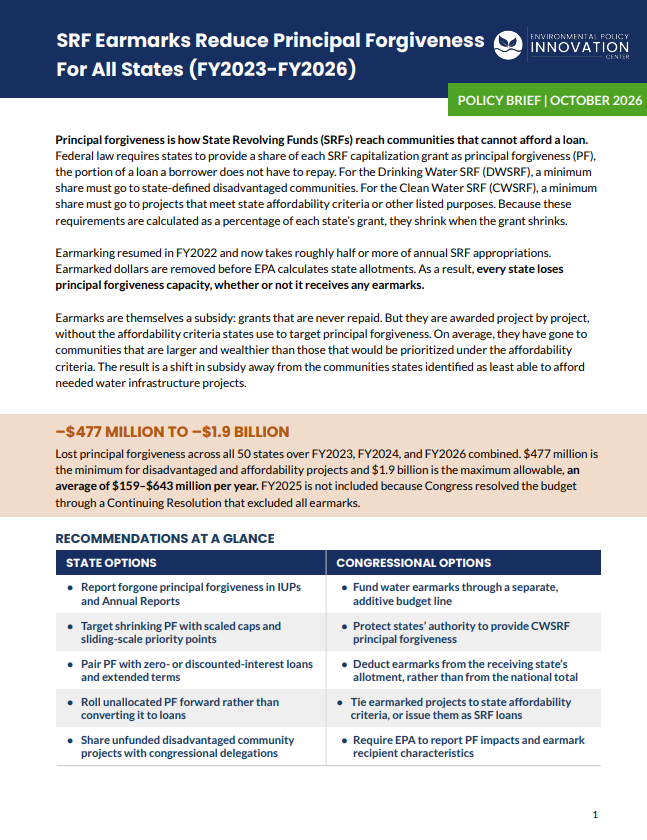
Each state must provide a portion of its SRF capitalization grant as principal forgiveness, the share of a loan a borrower does not have to repay. States use it to make projects affordable for communities with limited ability to take on debt. Principal forgiveness is calculated as a percentage of each state’s allotment (10–40% for clean water SRFs and 12–49% for drinking water SRFs), with a minimum reserved for state-defined disadvantaged communities and projects meeting state affordability criteria.
Since FY2022, Congress has funded water earmarks from SRF appropriations before EPA calculates state allotments. This, in turn, reduces the amount of principal forgiveness available to states. As such, every state loses principal forgiveness capacity whether or not it receives any water project earmarks. Across FY2023, FY2024, and FY2026, that reduction is approximately $477 million to $1.9 billion nationwide, an average of $159 to $643 million per year. Unlike earmarks, principal forgiveness is directed through publicly vetted state criteria to the communities least able to pay.
This brief quantifies the principal forgiveness loss by state and provides recommendations for state programs and Congress.
For more information, please see: policyinnovation.org/state-revolving-fund-earmarks