New: SRF Earmarks Reduce Principal Forgiveness For All States (FY2023-FY2026). Download Policy Brief →
The Impact of SRF Earmarks
Earmark: A portion of appropriated funds a member of Congress directs to a specific, local project (such as a water infrastructure project), rather than distributing it through a program’s standard competitive or formula-based process. Formally known as Community Project Funding (CPF) in the House and Congressionally Directed Spending (CDS) in the Senate.
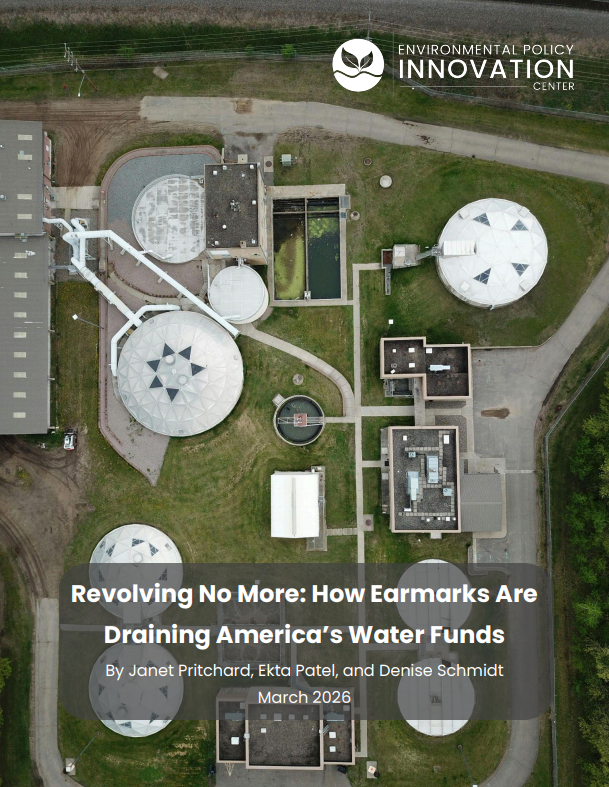
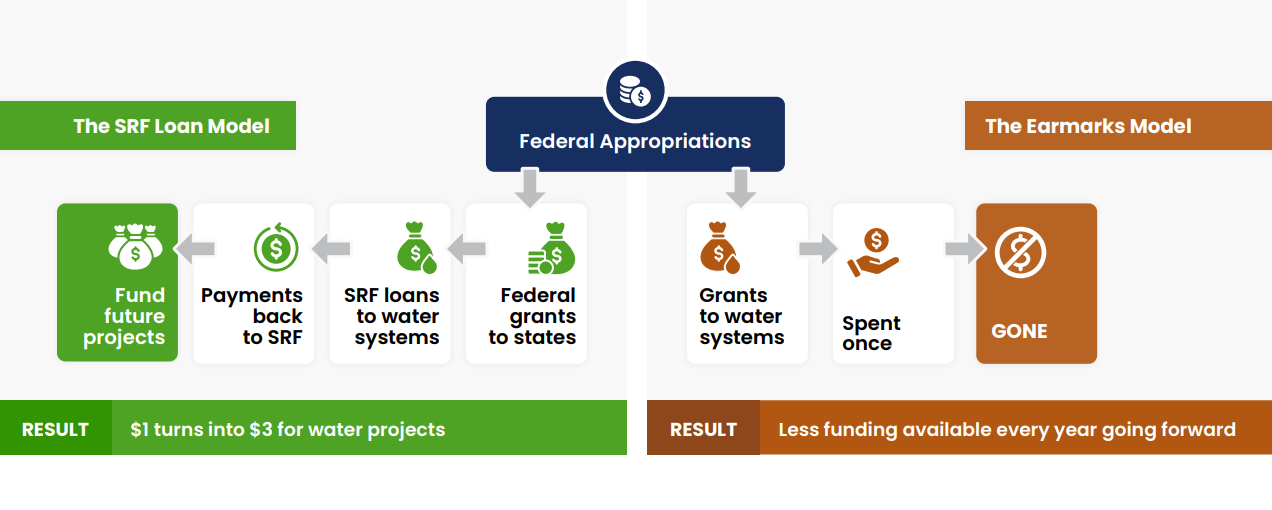
For decades, the Clean Water SRF (CWSRF) and Drinking Water SRF (DWSRF)—the federal government's primary mechanism for financing water infrastructure—have provided almost $230 billion for drinking water, clean water, and stormwater projects through 2023. States repay these loans, and the money is lent out again, so a single federal dollar funds project after project.
Congress paused earmarks government-wide from 2011 to 2021. They returned in FY2022, and in recent years, Congress has earmarked more than half of SRF appropriations. Earmarks are funded as one-time grants instead of loans—breaking the core feature that makes SRFs so effective: their ability to revolve.
See How Earmarks Weaken America's Infrastructure Funding Capacity
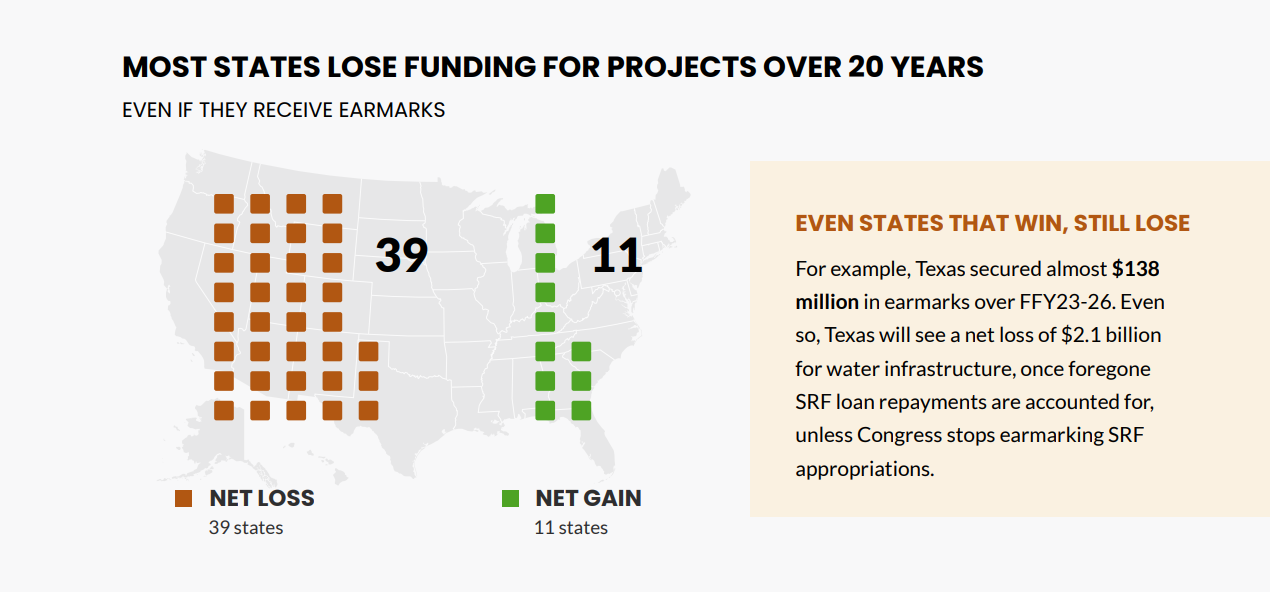
Over a 20 year period, states will experience a net loss of $19.4 billion if earmarks continue at their recent levels. That’s enough to finance approximately 5,700 projects.
Earmarks reduce long-term funding in 39 states over 20 years, and ALL states lose resources for technical assistance, program administration, support to state and local drinking water staff, and additional subsidies—the primary affordability tool for small, rural, and under-resourced communities.
Report Last Updated: 04/13/2026
Policy Briefs
-
SRF Earmarks Reduce Principal Forgiveness For All States (FY2023-FY2026)
Every state loses principal forgiveness capacity, whether or not it receives any earmarks.
10/02/2026
-
SRF Earmarks Reduce Set-Aside Funds For All States (FY2023-FY2026)
Earmarks reduce set-aside allowances in every state, leaving fewer funds for staff, technical assistance, and SRF program management.
08/25/2026
-
EPA OIG Audit Confirms Water Earmark Award Delays: Recommendations for Congress
EPA's own watchdog found the agency hasn't awarded 44% of earmarked water funds from FY2022-2023.
07/31/2026
-
Two Recommendations to Strengthen the SRFs: Reauthorization and Separate Earmarks
Recommends Congress sustain FY2026 SRF funding levels and fund earmarks through a separate budget line — the practice used for 21 years before 2011.
07/16/2026
Recommendations
The following recommendations are designed to protect the revolving model while addressing Congress’s continued use of earmarks.
Stop earmarking SRF appropriations
If Congress continues the practice, it should first require a study on the impact to SRF programs, and deduct any earmarks after the receiving state's capitalization grant has been calculated, not before.Fund earmarks through separate appropriations
This would preserve members’ capacity to earmark funds for selected water infrastructure projects.Set a statutory deadline for issuing earmarked funds
Put earmark awards on a one-year statutory clock, consistent with the standard EPA already applies to the SRFs.Require public reporting
Ask EPA to provide annual, project-level data on earmark awards, obligations, and remaining balances.Recapture stalled earmarked funds
Reallocate funds that miss the deadline through the SRF reallotment process EPA already runs.
Letters to Congress
September 4, 2026 | House Energy & Commerce Committee. Responds to the Drinking Water SRF reauthorization hearing, urging at least $5.85 billion in annual funding, separate appropriations for earmarks, and dedicated lead service line replacement funding. Read Letter (PDF)
May 13, 2026 | Senate Environment & Public Works Committee and House Transportation & Infrastructure Committee. Recommends reauthorizing the Clean Water and Drinking Water SRFs at the levels Congress approved in 2021, and creating a separate budget line for water earmarks. Read Letter (PDF)
SRF Earmark Data by Congressional Committee
See earmark and SRF data organized by the states represented on the following committees (119th Congress).
Contact Us
Have questions or interested in learning more? Reach out today!
Janet Pritchard, Director of Water Infrastructure Policy, janet@policyinnovation.org
Ekta Patel, Senior Policy Analyst, ekta@policyinnovation.org
Denise Schmidt, Director of Water, denise@policyinnovation.org