
Imagine a world where our food system is so automated and our plants are so well-engineered that not only does everyone have an abundance of protein and calories, not only is healthy, delicious food cheap enough that everyone wants to and does eat it, but also that all of that food is grown in a way that regenerates natural resources and biodiversity faster than they are being diminished.
That would be the definition of agriculture abundance.
Why define it at all? Because the loudest answer right now to agriculture’s (enormous) environmental impact is a politics of less: eat less meat, farm less intensively, be content with lower yields that feed fewer people. That answer asks people to accept scarcity as the price of a livable planet, and most people, understandably, decline the offer. Abundance makes a different promise. Your food can be cheap and filling, and also nutritious and delicious enough that you actually want to eat it. And it can be grown in a way that leaves the land, water, and wildlife better off–a goal any reasonable person shares. Real abundance means yield that delivers quality, not just tonnage. You should not have to choose between a good meal and a good planet.
Just as humanity has chosen in the last century to dramatically reduce scarcity of calories and protein, we can choose in the next century to use agriculture to produce more of nutrients and ecosystem services. That we are not is due to man-made barriers: paying for conservation practices rather than for results, starving the specific research tools that would let every acre do more, and hamstringing deployment of one of the most transformative technologies we’ve ever discovered.
This series will describe what the abundance movement could mean for agriculture, focusing particularly on my area of expertise in conservation and crop agriculture for food. There’s much more we could talk about–from producing more and better fiber to a framework for improved animal welfare–and I hope others will join in the conversation using the abundance frame to contribute in their areas of expertise. But let’s start with defining agriculture abundance and the problems it can solve.
Agriculture satisfies multiple levels of needs
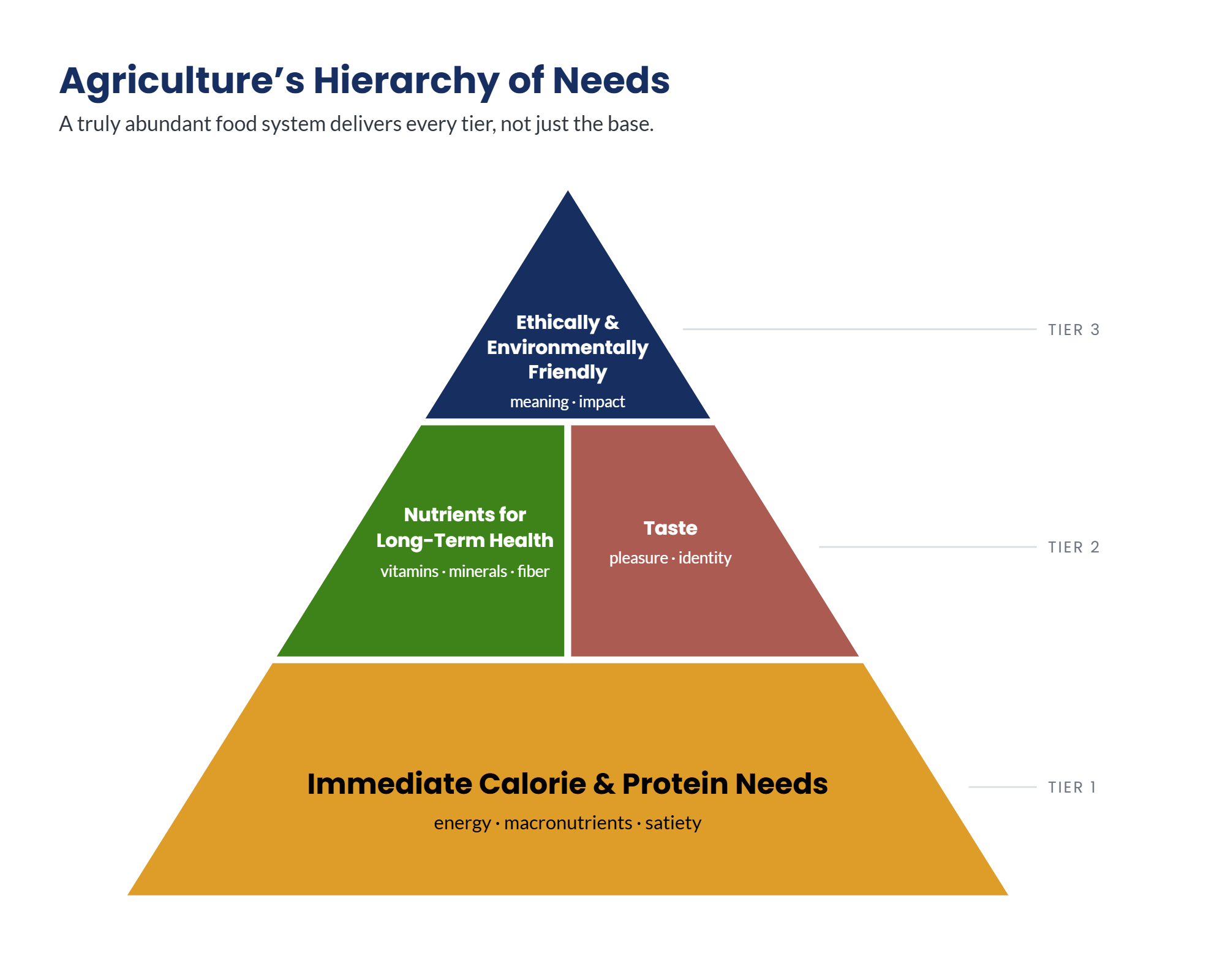
For most of recorded human history, if the goal was “produce more of what matters,” the number one thing that mattered was food. In a limited sense, we already have agriculture abundance: the world produces more calories and protein than ever, and U.S. farms grow several times the calories Americans eat.
But, because humans have a hierarchy of needs, as we are able to satisfy that base layer of immediate calorie and protein needs, the next tier of food needs for longer-term nutrition (vitamins, minerals, etc) emerges. For people to actually want to consume these nutrients, the foods producing them also have to be tasty and desirable.
Moving further up the hierarchy of needs, we see in wealthy societies that food can also produce self-actualization as people make choices that align with their ethics, particularly around environmental sustainability.
An abundant agriculture system needs to produce base caloric and protein needs, long-term nutrients in a package people want to eat, and improvements to the environment.
Produce more on less
Feeding a wealthier, growing world— USDA projects 47% more crop calories needed by 2050 relative to 2011—is a solvable problem if we do not care about the other tiers of needs. In other words, producing enough calories and proteins for a growing world can be done by filling in the wetlands, tearing down the rainforests, and of course rebalancing our diets towards calorie-dense, nutrient-poor porridge–but that prevents fulfillment of the full hierarchy of needs that agriculture can provide.
Natural lands deliver environmental outcomes that farmland cannot. A cornfield provides more carbon storage than a parking lot but far less than a forest. Those water filtration abilities, the habitat, and the biodiversity are lost at the moment of conversion. Food and nature are therefore not truly opposed; they are reconciled by yield. The more food we grow per acre, the more land can be “spared” for the natural ecosystems that do the heavy lifting for the climate and for biodiversity. Higher yields on working land are what make a regenerated planet affordable.
But “yield” has to mean more than tonnage. A food system that maximizes only bulk calories serves the most basic physiological need and stops there. That is why real abundance means yield that delivers quality, too—more antioxidants in a blueberry for heart health, lower oxalate spinach so calcium is more absorbable, sweeter carrots so people actually want to eat adequate fiber.
So to maximize production of all three tiers of needs, more and better food has to be produced on less land, sometimes called “land sparing”.
The Problems
Yield growth is slowing. The engine of land-sparing is sputtering. After decades of gains, productivity growth for major crops has flattened—globally going from 1.96% annually in the first decade of the 21st century to 1.31% in the second decade—under mounting disease and drought pressure, the exhaustion of past “low-hanging fruit” in breeding, and chronic underinvestment in the public research that drove the gains in the first place. We are losing momentum precisely when we need to accelerate.
Quality has quietly eroded. Studies find that common vegetables are measurably less nutrient-dense than they were decades ago. The causes are several and still debated, including the dilution that comes with breeding for uniformity and shippability rather than nutrition, changes in soil and growing conditions, and even increased CO2 concentrations.
Conservation pays for the wrong things. The dominant model for farm conservation is “cost-share”: a farmer agrees to install a practice from an approved list, and the government reimburses typically half of a government-estimated cost. Everyone gets the same payment if they install the practice, rather than varying based on how well it works. Thus, practices aren’t targeted to the most effective areas, farmers have no incentive to produce better results, and there’s little pressure to reduce costs through technological innovation.
This is abundance
Agriculture abundance is growing more and better food people can afford on less land while regenerating the landscape, by (1) buying environmental outcomes, not practices; (2) steering funds to high-risk research on crop breeding and automation that raises output and quality per acre; and (3) clearing the path to deploy genetic engineering solutions as they are developed.
The three pillars of this series will describe how to increase supply across the full hierarchy of what food provides: more calories and protein, more quality nutrition that tastes good, and more ecosystem services for a regenerated landscape.
That goal of increasing supply–rather than rationing it–is clearly aligned with the Abundance movement, but so are the means to achieve it: measuring success by outcomes rather than process, competent public administration, and new technology as the lever of progress. The alternative remains the politics of less, which asks people to give up yield, health, and the simple joy of delicious cooking to ease our environmental toll.
It is the wrong trade, because it is a false one. We can grow more and better food, and a healthier planet along with it. This series will explore how.