🔎Legislative Scanner
Check out EPIC's legislative scanner to keep track of all the state LSL bills worth keeping an eye on.
Federal Updates
EPA releases updated LCRI guidance
EPA released updated versions of its two LCRI guidance documents to help utilities navigate questions around service line inventories and access to private property.
EPIC’s take: We were happy to seesome of our recommendations reflected in the updated guidance. However, there are still a couple of things that concern us—particularly with the access guidance.
Let’s start with the Good 👍:
EPA shifted focus from "access barriers" to "factors that affect access," highlighting examples of how local and state policies can help overcome these challenges and ensure full replacement.
EPA also included an Appendix with resources pointing to strategies and case studies for achieving full LSL replacement.
These are great additions because they point to policy solutions, not just ways to work around compliance.
Now the bad 🚩:
The guidance still suggests systems may not be required to replace the private side if customers refuse to pay or if customer consent is not obtained. It does not provide examples of how states and localities can remove these barriers (though some are included in the appendix). As we’ve said before, these flexibilities could unintentionally incentivize utilities, municipalities, or states to avoid full replacements by adopting cost-sharing models or creating legal customer-consent requirements. Unlike state and local laws, utilities can choose whether to adopt cost-sharing—meaning that they could effectively create their own barrier to full replacement.
State Updates
Wisconsin releases new guidance and dashboard to streamline inventories
Wisconsin is giving utilities new tools to prepare for the November 2027 deadline. The state’s Department of Natural Resources is launching a dashboard to streamline inventory data submissions along with guidance on using statistical analysis to classify unknown lines for systems that meet specific criteria. DNR is also providing free technical assistance to support inventories and replacement efforts.
EPIC’s take: 👏A great example of states helping utilities prepare for LCRI compliance. Clear guidance, practical tools, and technical assistance can go a long way toward helping systems understand what is required and complete the work that is needed. Creating pathways for utilities to use tools like statistical analysis and modeling can also reduce the burden of physical verification, particularly for low-risk systems, saving time and resources that can be better directed toward replacement and other priorities.
Illinois bill to change SRF priority scoring stalls
IL HB4763 would have required the Illinois EPA to update the SRF priority scoring criteria to consider age of housing and prioritize communities with a higher lead burden. The bill passed committee in the House but did not advance to the floor.
EPIC’s take: 👎 A Disappointing outcome. Housing age is tightly correlated with the likelihood of LSLs, so incorporating it into SRF project ranking could help direct funding toward communities with the greatest needs. This is an approach we’ve advocated for not only at the state level, but also in how EPA allocates federal LSL funding to states.
Local Updates
💡Spotlight
Syracuse, NY launches a dashboard to keep residents informed about LSL replacement progress.
EPIC’s take: 👍Transparency is a good thing! Keeping residents informed about where and when replacements are happening can help build public support, increase program participation, and ultimately accelerate replacement. That kind of transparency can be particularly valuable for Syracuse as the city works to rebuild public confidence following recent controversy around lead testing.
🚧Hurdles
More cities worry about stalled replacements as federal funding dries up. Cities like Minneapolis and St. Paul, MN, and Waukegan, IL, have made meaningful progress toward removing lead service lines. But with IIJA funding expiring this year and no clear signal for future federal LSL appropriations, communities are facing questions about how to maintain that momentum. Waukegan, for example, reports that private-side replacements can cost between $10,000–$15,000 per line. This would be unaffordable for low-income households if those costs were passed on to customers when they can no longer rely on federal funding.
EPIC’s take: 🚩 Federal & state funding will be critical to sustain momentum and ensure LCRI compliance. With federal funding winding down just as LCRI compliance deadlines approach, utilities and states will need to find new ways to fund replacements. While DWSRF reauthorization could create an opportunity for dedicated LSL funding, it would likely not be enough to replace the estimated 4 million remaining LSLs. States will need to step up with their own funding, while utilities will have to get creative in combining funding and financing tools.
Will you be at AWWA WIC?
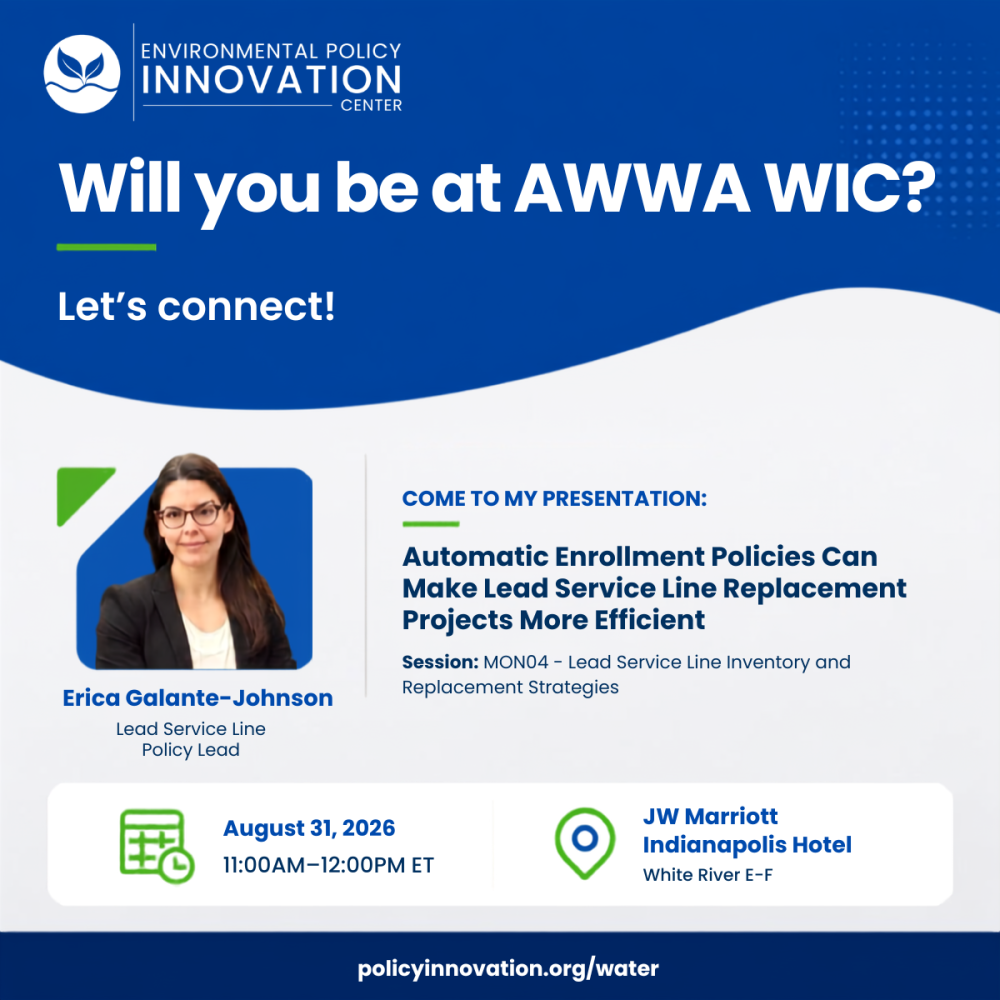
Don't miss my presentation on how automatic enrollment policies can help water utilities overcome barriers and accelerate lead service line replacement. And if you’ll be there, let’s connect over coffee!
Want to learn more?
Visit EPIC's LSL Policy Lowdown page, LSL Replacement Initiative page, and our Lead Innovation Hub.