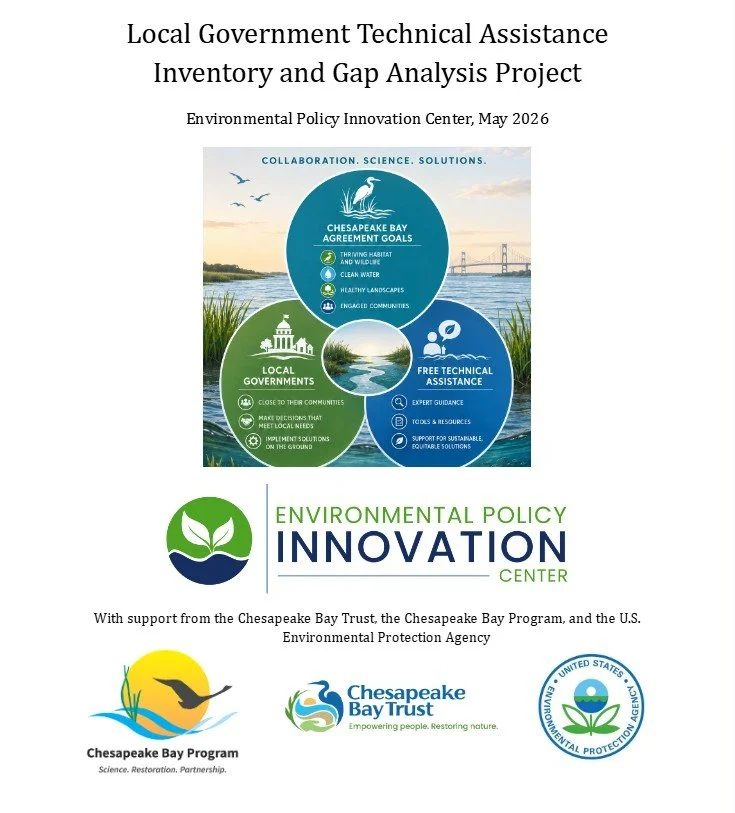
The Chesapeake Bay Program’s wide-ranging, multi-state effort to improve water quality in the Chesapeake Bay while improving the environmental conditions for all people and wildlife who call the Bay home is largely implemented at the local level. The more than 1,800 local governments within the Chesapeake Bay watershed have a critical role to play in understanding the environmental challenges, solutions and opportunities that exist within and across their jurisdictions. The Local Government Leadership Workgroup (LGLW) and the Local Government Advisory Committee (LGAC) of the Bay Program have worked to support local governments in advancing environmental projects that can help meet the Chesapeake Bay Agreement goals. A key area of work has been understanding where and how technical assistance (TA) can provide local governments with the knowledge, tools, capacity, and expertise to identify and implement these projects. LGAC recently recommended to the Chesapeake Bay Program Executive Council that TA programs for local governments be expanded in the Bay states. In response to this recommendation, the Chesapeake Bay Program Management Board committed to identifying currently available local government technical assistance. To meet this commitment and guide resource allocation decisions, the Local Government Technical Assistance Inventory and Gap Analysis Project was implemented in order to provide information to the Bay Program and constituent states on the scale and scope of current TA providers and programs (TAPs) across the Bay watershed.
The project focused on free TA available to local governments across the six Chesapeake Bay watershed states (Delaware, Maryland, New York, Pennsylvania, Virginia, and West Virginia) that is relevant to the Chesapeake Bay Agreement goals. Through desk research, interviews, and circulation of a standardized data collection tool, the project identified 122 TAPs (collated into a TAP inventory) that support achievement of the Chesapeake Bay Agreement goals. The TAPs include academic institutions, state and federal agencies, nonprofit organizations, and various collaborations and partnerships. The TAPs cover a broad range of Bay Agreement goals and provide TA to many different communities across Bay states.