
Congress is proposing changes to the Endangered Species Act. They’re not all bad. I highlight amendments that are common sense and could help incentivize voluntary restoration and protection of listed species, along with one important change we’d like to see.

OK, can I level with you? I’ve spent multiple days reviewing the ESA Amendments Act of 2025 (H.R. 1897), and I’m still not done! Maybe it’s because I’m such a research nerd that I have to look at every edit and contrast it with recommendations EPIC has made in the past. Or maybe it’s just that there are a lot of details thrown into this Act. So a big caveat is that I’m just providing the first slice of commentary. More to come.
What I’d Like to See Changed
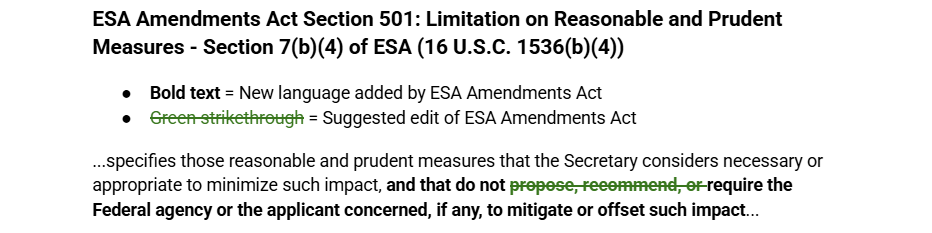
I would like to see the Act retain mitigation as a permit streamlining measure and as an incentive to private sector restoration and protection of listed species in advance of impacts. Specifically, I hope Congress removes “propose, recommend, or,” in Title V, Sec. V1(1). The Ecological Restoration Business Association is also advocating for this change. See screenshot of markup below.
What We Support - the Quick Take
Changes that remove permitting barriers and disincentives forvoluntary restoration and protection of listed species:
The entire newly proposed Section 10(k) codifying the USFWS rule on voluntary conservation - we particularly appreciate “Exemption from consultation requirement.—An Agreement approved under this subsection shall be deemed to have been granted an exemption under section 7(h) for the purposes of that section.”
Similar text added to Section 10(a) [for Habitat Conservation Plans]: “(3) A permit issued by the Secretary under this subsection shall be deemed to have been granted an exemption under section 7(h) for the purposes of that section.”
“(4) The issuance of a permit under paragraph [10 (a)](2) shall not be considered a major Federal action under section 102(2)(C) of the National Environmental Policy Act of 1969 (42 U.S.C. 4332(2)(C)).” [Exempts voluntary conservation agreements from NEPA]
[4(b)(1)] “(C) In making a determination under subsection (a)(1) with respect to a species, the Secretary shall take into account and document the effect of any net conservation benefit (as that term is defined in subsection (k) of section 10) of any Candidate Conservation Agreement with Assurances or any programmatic Candidate Conservation Agreement with Assurances (as those terms are defined in that subsection) relating to such species.”
Note on terminology: Throughout the Act, I’d suggest editing the term “Candidate Conservation Agreement with Assurances” to the term used in the USFWS May 2024 rule - “Conservation Benefit Agreement”
Longer Musings on What We Can Get Behind
Codifying the existing practice of publishing a National Listing Work Plan annually, with a schedule for completing all listing decisions in a 5-year timeframe. The legislation sets deadlines for petitions to list or delist a species– we agree, we frequently advocate for deadlines for permitting (or in this case listing) processes. The work plan will also include a priority classification, which also has been the practice of the Services. In addition to this pragmatic way of prioritizing species, we would point to more sophisticated ways to categorize extinction risk developed by multiple organizations and governments. We’ve previously notedin a Wall Street Journal Op-Ed that “...the International Union for the Conservation of Nature, the state of Florida, New Zealand and the nonprofit NatureServe. These are far more transparent and quantitative methods that use science to understand the differences between more and less threatened species.”
Counting the benefits of Candidate Conservation Agreements with Assurances when making a listing decision. This idea will help incentivize stakeholders to conserve species to the point where it precludes the need for listing.
Side note: We respectfully point out that CCAAs were subsumed by / are now called Conservation Benefit Agreements (as of May 13, 2024, see Federal Register notice). The text should be edited to reflect the terminology, Conservation Benefit Agreements, which encompass CCAAs and Safe Harbor Agreements.
Codifying voluntary conservation tools in ESA law. The legislation adds language that confirms Congressional intent in providing landowners with an opportunity to conserve species and reduce the concern of regulatory and monetary burdens. One additional clarification could be that the legislation allows the agreement to cover “species that the Service determines have a reasonable potential to be considered for listing during the permit’s duration. An incidental take or enhancement of survival permit need not include a listed species.” This was language that we supported in the Conservation Benefit Agreement rule that went into effect in May of 2024. There are additional smart elements from that 2024 CBA rule that could provide additional assurances for landowners (see the latter half of our blog). Subsection E could also include language allowing a landowner to return to the baseline population level - this is a helpful clarification and lets landowners know that they are not on the hook for impacting an expanded population if their efforts are beneficial to the species. We would also suggest the following language to provide assurances to neighboring landowners: “The Director may provide incidental take coverage in the enhancement of survival permit for owners of properties adjacent to properties covered by the conservation benefit agreement…” (from CBA rule, 2024).
We support stipulating a deadline of 120 days to reach a decision.
We greatly support this element: “(8) [Conservation Benefit Agreement] Exemption from [Section 7] consultation requirement.—An Agreement approved under this subsection shall be deemed to have been granted an exemption under section 7(h) for the purposes of that section.” as well as Section 10(a) addition - “(3) A permit issued by the Secretary under this subsection shall be deemed to have been granted an exemption under section 7(h) for the purposes of that section.” Bravo! We have written recently that:
[For approved Section 10 Habitat Conservation Plans or Conservation Benefit Agreements] “It is a meaningless procedural step for the agency to carry out section 7 consultation on its action of approving an agreement or plan. The section 7 documents are not provided to the public, are repeatedly described as a waste of time by staff who write them and have no unique provisions since section 7 considerations are already factored into the review and approval process of the agreement or plan. The agency should revise regulations and guidance to stop wasting time on the section 7 document by stating that the approved section 10 documents satisfy section 7 requirements.”
We also support exempting Conservation Benefit Agreements from NEPA: “(4) The issuance of a permit under paragraph (2) shall not be considered a major Federal action under section 102(2)(C) of the National Environmental Policy Act of 1969 (42 U.S.C. 4332(2)(C)).” We have written recently that:
“Conservation Benefit Agreements are not major federal actions. We agree with others that a (simple) categorical exclusion is appropriate for most net benefit HCPs or ones with minimal effects. Conservation Benefit Agreements should not even require a categorical exclusion since they are simply not a major action.”
The one subsection in the discussion of voluntary conservation agreements that we do not agree with is exemption from disclosure, although exemption from personally identifiable information or proprietary information would be appropriate. When a CCAA was developed in West Texas with no public disclosure, analysis of satellite imagery identified surface disturbances contrary to the agreement - underscoring the need for more than “trust us.” Better to trust but verify.
Excerpt of Habitat Disturbances under the Texas Habitat Conservation Plan for the Dunes Sagebrush Lizard(Li et al; 2013): “The Texas Comptroller of Public Accounts, as the permit holder for the plan, is required to “monitor and track surface disturbing activities” and report monthly to FWS on the total acres of habitat disturbance. We obtained all monthly monitoring reports submitted as of May 24, 2013, each claiming that zero acres of actual lizard habitat had been disturbed across the over 138,640 acres enrolled under the Texas Plan. The annual report further states that “there were no disturbances impacting DSL habitat by Participants in 2012” and “no new surface disturbances by Participants in 2012.” The report cites “no compliance issues by Participants in 2012” and “no exceptions to [habitat] avoidance” requirements during this time… This report documents multiple instances of surface disturbance on habitat enrolled under the ConocoPhillips Certificate of Inclusion. We describe how we identified the disturbances and show aerial images of the most obvious examples… Our report underscores the need for FWS to structure conservation agreements in a way that allows the agency to verify whether permit holders are fulfilling their conservation commitments.”
We also support clarification about recovery goals. Research in peer reviewed literature provides evidence that the presence of a recovery plan and clear criteria improves species recovery outcomes (Taylor et al. 2005 and Haines et al. 2021). Other peer review literature supports objective, measurable, and scientifically justified recovery criteria (Himes Boor 2014 and Doak et al. 2015). However, the language currently only says the Secretary shall “(i) establish objective, incremental recovery goals”-- adding “measurable, and scientifically justified” is a must considering the proposed streamlining of delisting once criteria are met. Other subsections appear reasonable on the face of it:
Decreasing stringency of regulation as recovery goals are met is theoretically an interesting way to create a return on investment for conservation, although it would be helpful to understand better how that might work.
Requiring a status review and option of delisting upon meeting recovery criteria is reasonable [provided public comment is considered].
Shifting oversight of species management to states when recovery criteria are met is pragmatic, as the states would have jurisdiction if and when a species was federally delisted.
Considering a state’s recovery strategy be adopted as a recovery strategy (with a 120-day deadline on deciding whether or not to use it) is in theory reasonable.
The one subsection in the discussion of recovery criteria that we do not agree with is the very quick turnaround time of a delisting decision (30 days) if recovery criteria are met, and the removal of judicial review of delisting said species. How believable is the evidence that the recovery criteria have been met? Will that evidence be made public?
The legislation proposes to exempt lands covered by HCP and CBA agreements/plans from critical habitat designation. This could be a huge incentive to participating in voluntary conservation to the benefit of the species, provided that HCPs and CBAs truly are solid plans that benefit the species.
What We Would Absolutely Change
Removing mitigation as an option of a “reasonable and prudent measure” for Section 7 consultation. Mitigation can be a way of fast-tracking a project by letting a permit applicant who wants to develop a project let them develop a project and let restoration specialists help offset any impacts. Developers want to develop, not figure out how to deal with birds and bunnies. The Act should not completely cut out mitigation as an option, although clarifying that mitigation is not “required” is reasonable. Specific recommendation to Congress: cut out “propose, recommend, or” in Title V, Sec. V1(1).
The More Controversial Things - and Are They That Bad?
The legislation proposes changes that will be controversial in the environmental community - but the thing is, we’ve seen this before in the Trump I era changes to ESA in 2019 and the sky didn’t fall down. But there are some caveats, chief among them is that the Biden Administration rescinded Trump era changes less than 5 years from when they became effective. There wasn’t a long time to be able to tell how changes played out, if at all.
Removing the 4(d) “blanket rule” (which in a nutshell automatically extended endangered-level protections to threatened species). HR 1897 flat-out strikes this text, and US FWS leadership have also indicated they would remove the blanket 4(d) rule as a rule (a proposed rule is sitting with OMB for interagency review as of June). It’s worth noting that NOAA Fisheries has adopted this approach since the beginning of the ESA. And the Trump administration removed this before, although since the Biden administration whiplashed a rescission of that change, there was little time to see an effect of the removal of blanket protections for threatened species. As we noted in 2018 (hat tip: Jake Li),
“For some species, I think the withdrawal would probably make no real difference because FWS was already on the path to issuing more of these species-specific 4(d) rules. As you can tell from the chart in Figure 2, under the Barack Obama Administration, even FWS was quite active in issuing more and more of these species-specific 4(d) rules. I don’t have any reason to think that the pattern would change in a way that would decrease the number of those rules. I think, for those types of species, withdrawing the general 4(d) rule probably isn’t going to make much of a difference one way or another.
But for other categories of species, I do think withdrawing the §4(d) rule raises some real concerns. In particular, for species that might have benefitted from the §9 “take” prohibition, if FWS doesn’t promptly issue a species-specific rule because it’s overworked, or it doesn’t have enough resources, then we can see a lapse in protection. We can see some lost opportunities for pursuing conservation plans and other conservation measures for those species. So, that’s one area of concern for this proposal.
The Trump Administration’s Proposed ESA Regulations, Environmental Law Review, 2018
Clarifying the definition of habitat - with relevance to the designation of unoccupied critical habitat. HR 1897 proposes a definition of ‘habitat’ that conforms to what was decided in the 2018 Weyerhaeuser Co. v. US FWS Supreme Court decision. That decision determined that an area must be “habitat” before that area could meet the narrower category of “critical habitat,” regardless of whether that area is occupied or unoccupied, but the decision did not go beyond this to define habitat. Here is the definition proposed in the legislation:
(D)(i) For the purpose of designating critical habitat for a threatened species or an endangered species under this Act, the term 'habitat'—
(I) means the abiotic and biotic setting that currently or periodically contains the resources and conditions necessary to support 1 or more life processes of the threatened species or endangered species; and
(II) does not include an area visited by only vagrant individual members of the threatened species or endangered species.
(ii) If the setting described in clause (i)(I) does not support all of the life processes of the relevant threatened species or endangered species, the threatened species or endangered species must be able to access, from the setting, other areas necessary to support its remaining life processes.
Here’s where I think this goes wrong: this definition does not acknowledge that the setting could be in a degraded state - and therefore would not “periodically contain [emphasis added] the resources and conditions necessary to support 1 or more life processes of the threatened species or endangered species.” A setting that historically had periodic low level fires which are now suppressed - aka a degraded habitat for species with fire-dependent life processes - would not currently or periodically contain the resources and conditions necessary, but for restoration and management such as prescribed fires. Additionally, section D(i)(II) about vagrant species is odd but seems to provide cover in the instance where a species might randomly show up but not be around for the long term - I don’t hate that. But D(ii) seems to indicate that if you don’t have 100% of the resources and conditions for the species life processes on the site, they better be next door (the species must be able to access, from the setting…), which just seems like it would lead to lots of scrutiny about whether all life processes are available in contiguous areas - an impossible task and likely to more money spent and litigation on both sides.
Here’s a better, simpler definition crafted after much deliberation by Rylander et al. (2020):
Habitat is the area or type of site where a species naturally occurs or that it depends on directly or indirectly to carry out its life processes, or where a species formerly occurred or has the potential to occur and carry out its life processes in the foreseeable future.
Removing climate change from what might be considered the “foreseeable future” when determining threats to species in listing decisions. OK, the bill doesn’t actually say “climate change,” but the Trump Administration’s framework last seen in 2019 was “The term foreseeable future extends only so far into the future as the Services can reasonably determine that the conditions potentially posing a danger of extinction in the foreseeable future are probable.” Back when this was proposed, many commentators claimed that this definition would restrict the ability to list species under the ESA, especially those affected by climate change. Based on an analysis of 447 ESA decisions from 2010 through July 2019 that interpreted the foreseeable future, EPIC determined that the average timeframe of the foreseeable future in those decisions was 46 years. At the time of the analysis, the current practice of the Services was generally not using extremely long timeframes in listing decisions (an exception: the use of an 88-year timeframe for the listing decision of the Arctic seal). My point is that not many species were listed because of an analysis of threats far out into the future. We do acknowledge that some species more likely to be influenced by climate change could in theory be harmed by this interpretation.