National Approach to Wildfire Data and Technology: Operations-Centered Innovation Pathways
Somewhere mid-way down the mountainous scrapheap of failed startups, one can find the dented chassis of a countertop juicer named the Juicero. The device ranged in cost from $400 - $700, was only compatible with proprietary QR-coded juice packs, and was ultimately superfluous as the packs could be snipped open for hand squeezing. It is a classic example of an over-designed solution for a non-existent problem that no one asked for.
To avoid Juicero debacles, the Wildland Fire Intelligence Center (WFIC) needs to establish an operations-centered innovation cycle from day one. Data and technology initiatives must be rooted in the explicit needs of the people who use those systems to discover new solutions and improve wildfire resiliency.
Not doing so will waste time and resources developing innovations that answer the wrong questions, fail when deployed, or simply don’t get adopted at all. Beyond that, the WFIC faces a particular challenge as an integrator of operations housed in other institutions. They must evaluate, adapt, and coordinate needs, resources, and capabilities from across those institutions to deliver on the opportunity in front of them.
With committed leadership dedicated to personnel-identified solutions, the WFIC can spin up a sustainable cycle of solutioneering that focuses the power of nation-scale data for acutely scoped needs.

Making the Juice(ro) Worth the Squeeze: Three T's for an Operations-Centered Innovation Pathway
To effectively modernize wildfire management, forest management, frontline operations, analytics, and research must take precedence when setting national priorities for data and technology. In a high stakes, capacity-constrained ecosystem, every decision – from which data to collect to which products to procure – must be tethered to end user needs: translating investments into action and forging a culture of trust.
The cycle relies on three critical structures with analogs from the National Weather Service (NWS) as reference points.
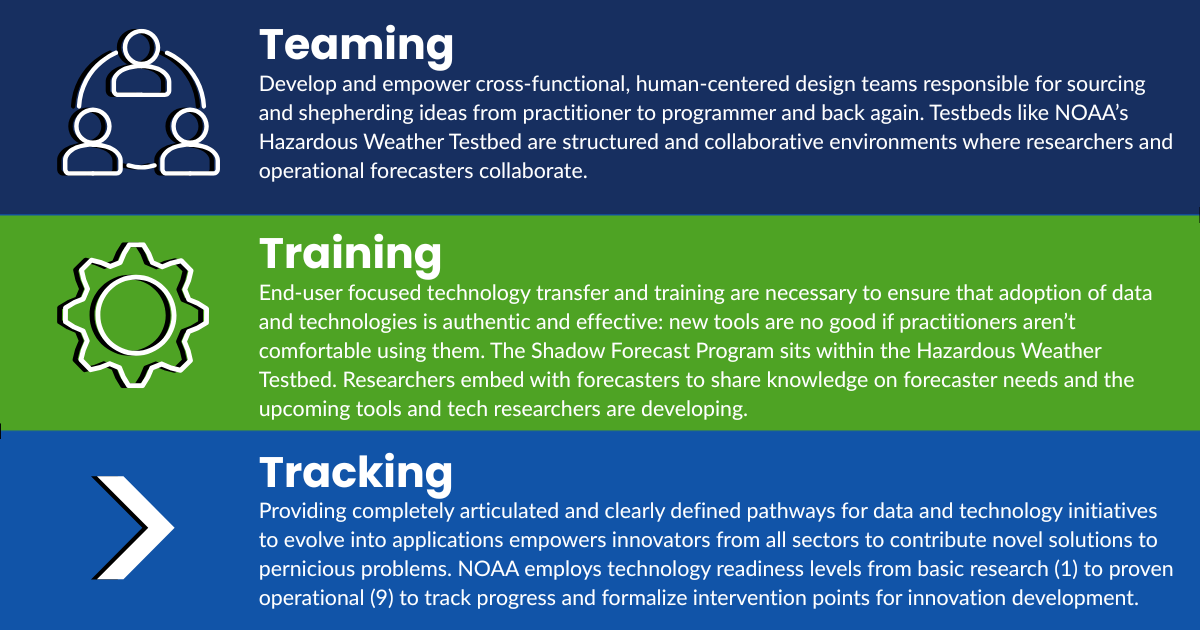
Operations-centered does not mean monodirectional; while practitioners push, leaders must pull. Executives in the WFIC and partner agencies need to step into the fray to ensure that money, clout, and time are allocated to projects with real promise.
For example, for large wildfire incidents, some experts envision the need for dedicated “Intelligence Officers” within Incident Management Teams (IMTs) to operationalize data for real-time decision-making. Expanding that logic to detail similar roles for prevention, detection, preparedness, mitigation, and recovery will improve the overall coordination of our response apparatus and save money, communities, natural places, and lives.
As they reach down their organizational chains, executives must also engage with the private sector, research institutions, and NGOs. The agility, ingenuity, and alternative resourcing these groups bring to the table pairs with practitioner expertise to drive entirely new lines of inquiry for impact. Beyond direct engagement, the WFIC needs to create an open-data ecosystem that enables external innovators to access and shape that data into value-added services. Open data and the interoperability that supports its use will be covered in more detail in the two blogs that follow.
Resounding Calls for the Operations-Centered Innovation Pathway
The calls for an operations-centered innovation pathway are clarion from experts across the board. Across our conversations, this was the single most cited priority. And the rankings weren’t particularly close.
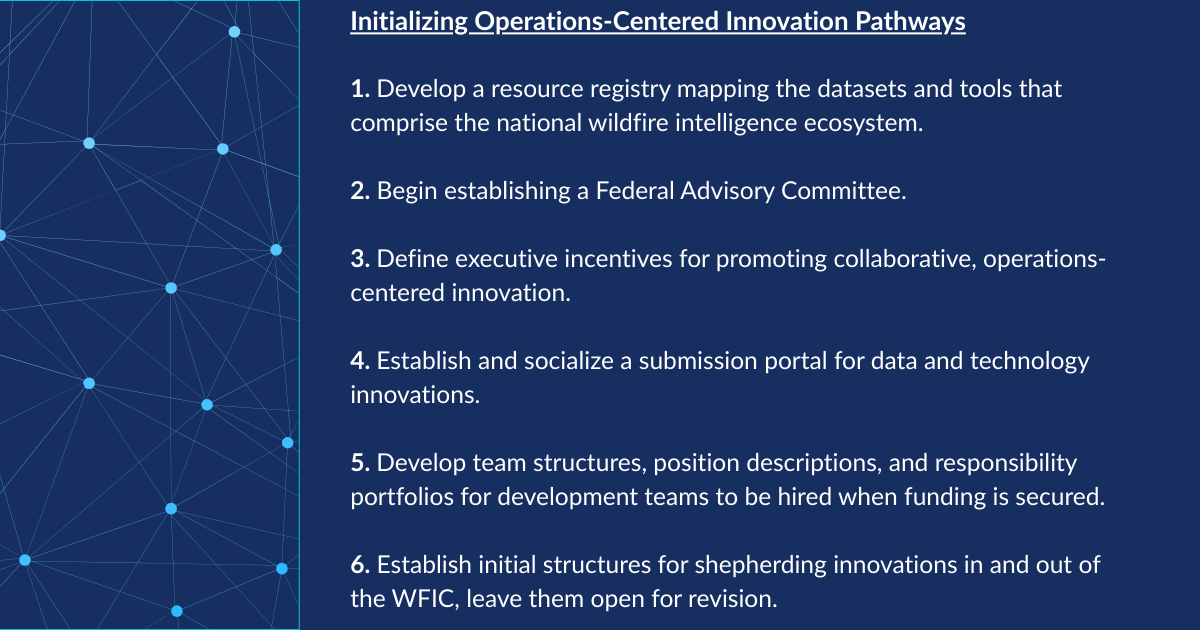
Wildland fire is an inherently place-based issue. Individual geographies ignite, burn, and recover differently. Community preparedness varies widely. Response resources are distributed differentially. While centralizing data and technology (including their governance and administration) has significant upside, doing so without prioritizing on-the-ground knowledge and needs will backfire. Testing, evaluation, and customization must prioritize regional reality. This work gets done on the ground. Their needs should steer the actions of supporting organizations like the WFIC.