National Approach to Wildfire Data and Technology: Effective Governance in an Open Wildfire Data Ecosystem
Introduction: A Crisis in Need of Coordination
Wildland fire management is at a critical turning point, driven by an escalating wildfire crisis, rapid advances in data and technology, and historic federal policy change proposals. Until now, the effectiveness of our wildfire response has been hampered by fragmented data systems scattered across agencies. This fragmentation is a system-wide translation failure that throttles the impact of technology in mitigating, managing and recovering from wildfires. We lack an entity dedicated to integrating existing data and expertise into a coherent sum, greater than its parts.
National Approaches to Wildfire Data and Technology
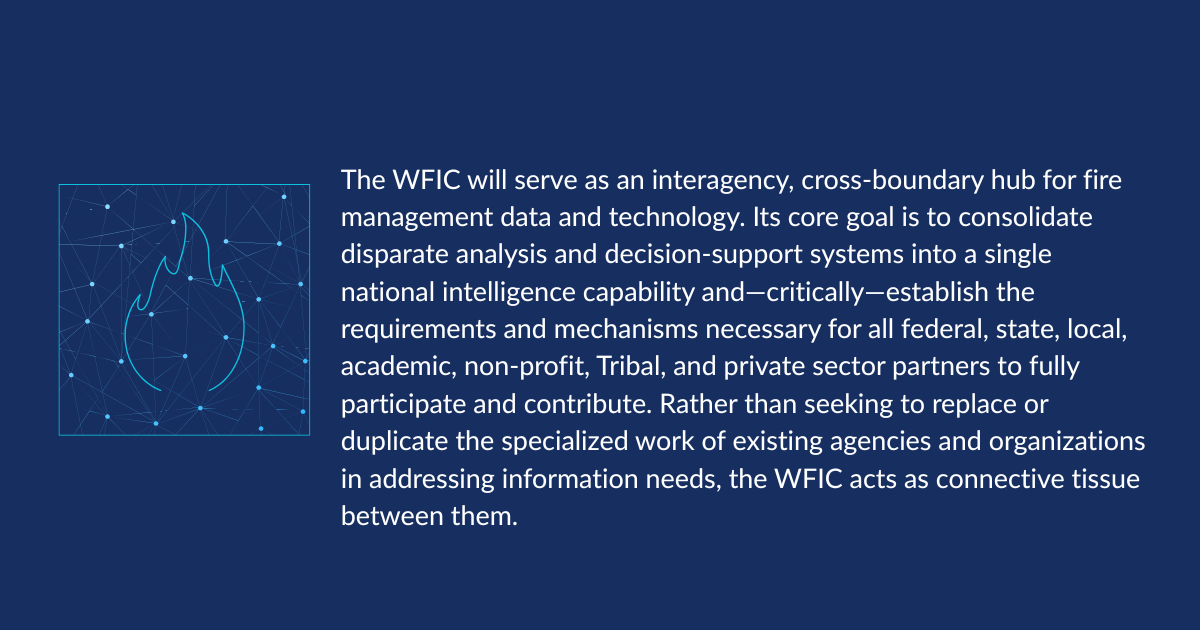
The proposed Wildland Fire Intelligence Center (WFIC) can create that essential integration layer to empower a modernized national strategy. Focusing on integration instead of reinvention is the difference between throwing out decades of good work to start from scratch, or fixing the broken parts of that system to help good work shine. The second is smarter, cheaper, and more politically feasible. The effort, money, and political capital saved in this approach can then be dedicated to identifying the remaining gaps or irreparable breaks and integrating new technologies to fill them.
By focusing on synthesizing diverse model outputs and standardizing observations into actionable intelligence, the WFIC addresses the translation failures of the current system. If successful, it would provide the delivery architecture necessary to turn scattered scientific data into a unified operational reality, addressing the crisis without getting snagged on the bureaucratic friction of organizational overlap.
Recent executive action and legislative proposals aimed at modernizing the wildland fire system—including the Fix our Forest Act (S. 1462 / H.R. 471), which would create the WFIC in statute—present real opportunities to shift toward a unified, technology-enabled, and data-centric strategy. However, poorly implemented changes within this already complex multi-jurisdictional ecosystem carry significant risks. Without diligent planning, design, and user input mechanisms from the start, as well as adaptability to address an ever-shifting technology and political landscape, these initiatives could produce an inverse effect. They risk failing to solve existing issues, creating new inefficiencies, or simply recreating old problems at a high cost to taxpayers and fire-prone communities.
“Priority Wins”
To inform an effective near-term transformation, the Environmental Policy Innovation Center(EPIC) and the Climate and Wildfire Institute(CWI) partnered to explore the pitfalls and possibilities of a national approach to wildfire intelligence. By synthesizing existing research and input from dozens of tech developers, researchers, and practitioners, we’ve identified four “Priority Wins” essential for near-term success.
The Roadmap: Four Priority Wins
The emerging strategy for national wildfire data and technology requires a foundational shift in how the overall system is managed.
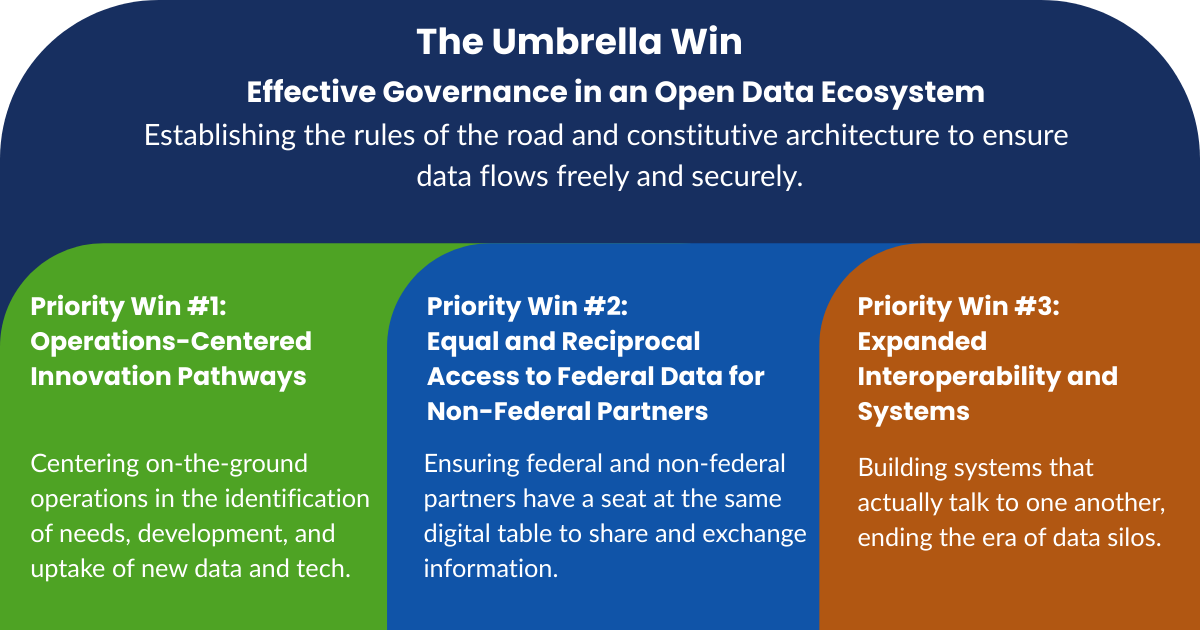
Effective governance is the foundation of this strategy. This post outlines fundamental governance recommendations needed to begin moving beyond data and tech silos in the next 18-24 months. In the coming weeks, we will dive deeper into each operational priority, or “Win,” illustrating how a well-governed, open wildfire intelligence ecosystem empowers researchers, protects firefighters, and ultimately builds more resilient communities.
Effective Governance in an Open Data Ecosystem
Wildland fire management is transforming as the scale and complexity of the wildfire crisis increases. However, in an ecosystem this complex, with stakes this high, change comes with significant risk. Thoughtful, focused governance that delivers on the needs and knowledge of expert practitioners, researchers, and other end-users is the best way forward.
Drawing from interviews, existing research, and a case study on the National Weather Service (NWS) produced as our model comparison, we’ve identified the following achievable governance priorities for the first 18-24 months of a national wildfire intelligence system:
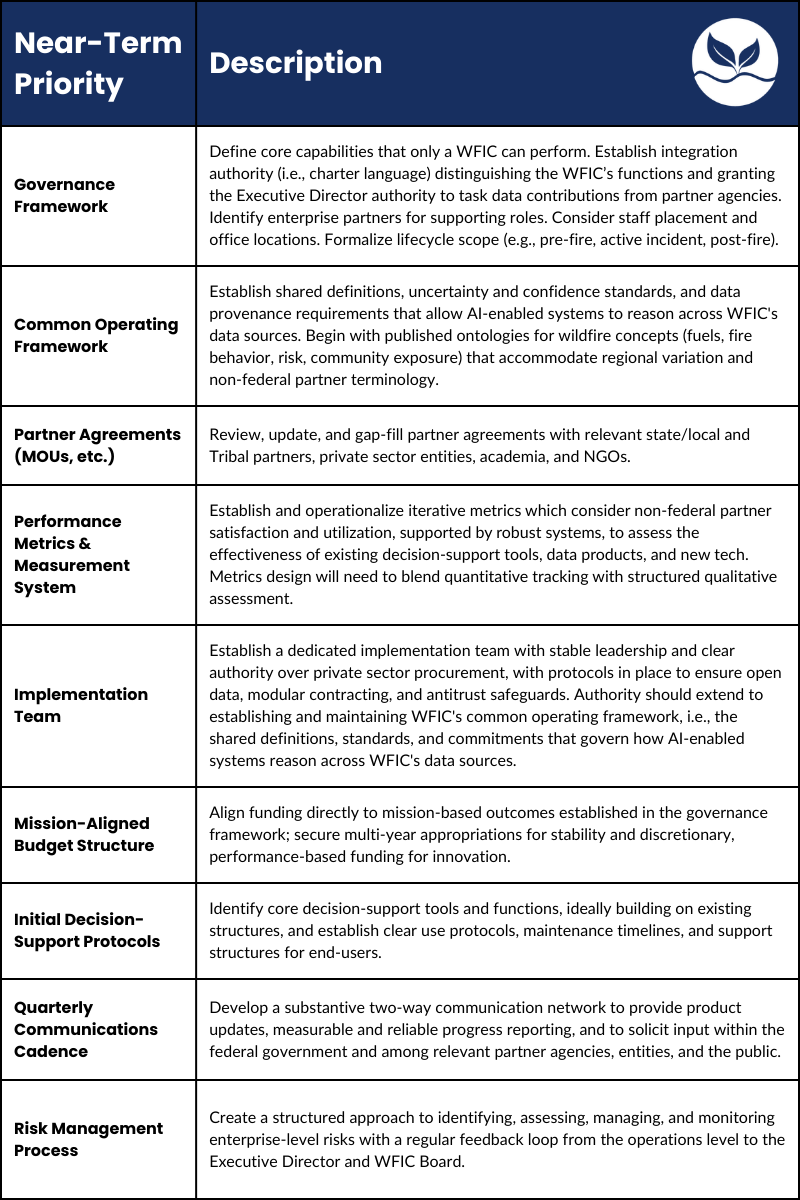
First Priorities for Implementation
A WFIC Executive Director and an Interagency Board, will be tasked with establishing the Center "as soon as practicable" and creating core data registries within 90 days.
This accelerated timeline creates a "sprint" scenario. Because key mandates are triggered immediately—likely before dedicated funding is fully appropriated—officials must stand up the new entity under existing capacity constraints. To set the WFIC on a successful path in this 90-day window, we suggest prioritizing:
A constituted governing board with a signed charter establishing its integration authority;
Executed MOUs with at least two federal partners, and one pilot state in negotiation;
Embedded liaisons deployed at NIFC and one pilot Geographic Area Coordination Center (GACC);
A functioning data integration environment aggregating initial feeds (e.g., building on efforts like NERIS); and
Prototype intelligence products incorporating data already in production for end users.
Success in this window requires moving beyond "rules of the road" to an operational governance model that creates seamless pathways for data from day one.
Looking Ahead
The next post in our series will shift from structure to function, focusing on the end user and key considerations for an ‘operations-to-research-to-operations’ pathway. We will explore how to develop and mainstream new technology based on real needs identified by those who need it the most. Stay tuned for more!