The Most Efficient Environmental Market You've Never Heard Of Is Growing Up
An update on Virginia's nutrient credit market, based on a conversation with Derick Winn, Nonpoint Source Trading Coordinator at the Virginia Department of Environmental Quality.
In 2019, our founder, Tim Male, called Virginia's nutrient trading program the most efficient environmental market you've never heard of. (He also pointed out in the piece that most people had never heard of any environmental market.)
Seven years later, undoubtedly more people know that environmental markets can be a tool for rapidly and effectively restoring the environment and offsetting impacts of necessary development. But what’s been happening to Virginia’s phosphorus market in that time?
It grew up.
I recently chatted with Derick Winn, who has worked on nutrient trading at Virginia DEQ since 2014. While Virginia approved its first nutrient bank back in 2008, no real market existed until around when Derick came on board. Almost two decades in, the state's program allowing developers to purchase credits that offset impervious surfaces by paying to keep phosphorus out of waterways has grown in size, leveled off, and continued to improve its procedures. Its speed is also notable; credit acquisition can be accomplished in as little as 24 hours once the buyer knows which nutrient bank they're purchasing credits from.
Four things stood out from our conversation.
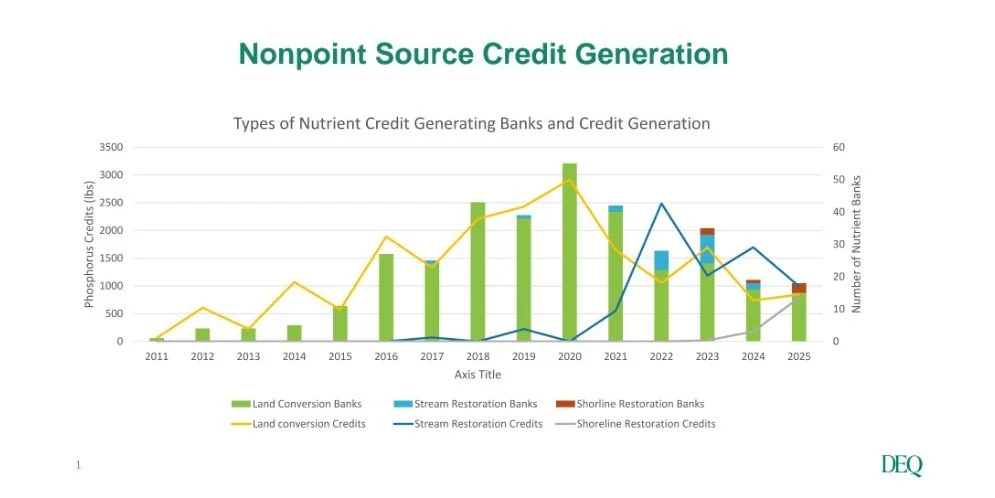
The market has found its equilibrium. Trades climbed year after year through 2020. They slowed down between 2021 and 2025, partially due to COVID. Now they have leveled out, both in trade volume and in credits generated.
The mix of projects flipped. Early on, land conversion generated almost all credits. Today, stream restoration generates more credits than land conversion, and living shorelines will likely pass land conversion this year as the second most common project type.
The savings are huge. Credits go for $15,000 to $20,000 per pound of phosphorus. Doing the same reduction on one’s own site costs closer to $50,000 per pound. And this price has stayed consistent over many years, meaning it’s decreased in inflation-adjusted terms.
Virginia keeps tweaking the market. They’ve updated crediting methodology and release schedules. The new Stream, Wetland, and Nutrient exchange, called SWaN, puts credit prices and availability out in the open for the first time.
Trade Volume
As mentioned above, trade volume grew through 2020 and has leveled off since. This image shows both the total number of banks created and the credits generated by each type of bank.
More information about the size of the market can be found in the July 2026 edition of the Mitigation & Nutrient Market Quarterly.
A Market That Flipped Itself
For years, critics knocked Virginia's program for leaning on farmland conversion to generate credits. In the early days, they had a point. Almost every credit came from turning farmland from production back to native trees.
Converting farmland to forest keeps a lot of nutrients out of a watershed, so–in a narrow sense–it works. But it is a hard sell politically when farm groups and neighbors want that land growing food.
As the market matured, the crediting methodology was updated to reflect improved science that farm to forest conversions were not preventing as much phosphorus as previously thought. Stream restoration now generates more credits than land conversion. Even though land conversion still comprises most of the applications, the projects tend to be smaller and generate fewer credits. Living shorelines are rapidly growing also, and Derick Winn expects that when the numbers for 2026 are fully tallied, more credits will come from living shorelines than from land conversion. Nobody banned anything; mitigation bankers just found restoration projects that deliver more value, and the market followed.
Land conversion still makes sense in some places. In a watershed with no streams or shorelines to restore, it is often the only tool you have. Ideally it targets land that should not have been farmed in the first place. Running the market totally on land conversion alone would not have been sustainable. And apparently the market figured that out.
Bigger and Better
Anecdotally, projects seem to be growing larger over time.
One example is a shoreline stabilization job with Norfolk Southern at their railyard in Lambert’s Point. It was only the second shoreline project the program ever approved, and it was the biggest bank approved up to that point–generating 2230 lbs of phosphorus credit compared to the previous largest that generated 752 lbs. Bigger shoreline and stream banks have already followed.
Bigger projects typically drop the price per pound through economies of scale. Cheaper credits make stronger compliance measures more viable, and that keeps more pollution out of the water.
The growth in project size may be one of the reasons why credits have consistently stayed around $15,000-20,000 over the past few years–even though the cost of everything else has increased over that time period.
Try Something, Learn From It, Try The Next Thing
One of the reasons Tim called Virginia’s market so efficient is that it “[was] showing adaptability over time”.
Virginia didn’t design a perfect market on day one. It actually ran a real one for almost twenty years, watched what worked, and kept adjusting. They onboarded new practice types, adjusted their credit release schedules, and have now created a public digital exchange.
As stream restoration and then shoreline stabilization projects applied to come online, the department had to develop ways to determine exactly how many credits they deserved.
The program also got smarter about releasing credits–something that we’ve written has been a key adjustment point for wetland restorations and Pay for Success programs. Stream projects can now collect up to 75 percent of their credits at construction. That gives bankers the predictability they need to take on bigger, more ambitious work. Shorelines do not get that accelerated release yet, but they might eventually.
For most of this market's life, finding the price of a phosphorus credit meant calling around and hoping someone would tell you. Suppliers used to guard their price point, which could create market inefficiencies.
SWaN is built to change that. The digital exchange that DEQ built with Water Ledger now allows buyers to see prices, and restoration project/bank owners to see when demand might outrun supply in a given watershed in a given year. DEQ likes it because they get a clearer view of where the market is headed. They can monitor prices and anticipate where there might be shortages.
SWaN is still getting up to speed. Some datasets are still not available. So, we haven’t really seen its impacts yet. But buyers are excited, and it’ll be a great thing to check in on the next time I write a piece like this.
There’s Still Room to Grow
While the market seems to have gotten out of its juvenile and adolescent stages, it can always keep learning and improving.
Some watersheds still run short on credits, though most shortages clear up fast. But there is one watershed where it’s almost impossible to generate credits. It’s possible that, as opportunities for shoreline and stream restoration are exhausted, more areas will use up all of the opportunities for existing mitigation types.
For that reason and others, mitigation bankers and market referees will need to keep looking for new kinds of practices.
There’s also plenty of research that can be done on this market to inform others. For instance, it would be fascinating to calculate how much money the market has saved compared to on-site mitigation. Pinning that down across every project would be a massive job, but it could be crucial for convincing other states why they should invest in starting a market that’s as efficient as Virginia’s.
I asked Derick how he defines success for this growing market, and he said that–while dollars saved is important–ultimately it’s the total number of credits generated. Every credit generated for this market is phosphorus that permanently stays out of Virginia's rivers, streams, and Bay.
Seven years ago this was the efficient environmental market nobody had heard of. In the time since then, it’s grown up, and every pound of phosphorus that it’s kept out of waterways is a reason more states should know about it.
Learn more about Virginia's nutrient trading program at deq.virginia.gov/news-info/shortcuts/permits/water/nutrient-trading and explore the SWaN exchange at swan.waterledger.com.