

Drinking Water Data for the Nation: Version 1.0 of the National Drinking Water Dataset + Explorer Tool Is Here
The tl;dr — After piloting a similar tool in Texas, building a national data pipeline covering 821 variables from 30+ datasets, and engaging stakeholders across the drinking water ecosystem, EPIC is releasing Version 1.0 of the National Drinking Water Dataset + Explorer Tool. It's free, open source, and built for anyone who needs to understand drinking water systems across the U.S. Explore the tool.
All Americans deserve access to safe, reliable, and affordable drinking water. But turning these principles into reality requires untangling a complex web of interdependent factors — and that requires data. Not just any data: connected, usable, trustworthy data that doesn't require a data science degree to understand.
That's the gap EPIC has been working to close. Today, we're releasing Version 1.0 of the National Drinking Water Dataset + Explorer Tool, a free, interactive mapping application that brings together 30+ state and national datasets — covering water system compliance, funding history, environmental hazards, census demographics, climate vulnerability, and more — into a single, harmonized, and openly accessible resource. This effort is done in partnership with New America as part of our Digital Service for the Planet (DSP) initiative.
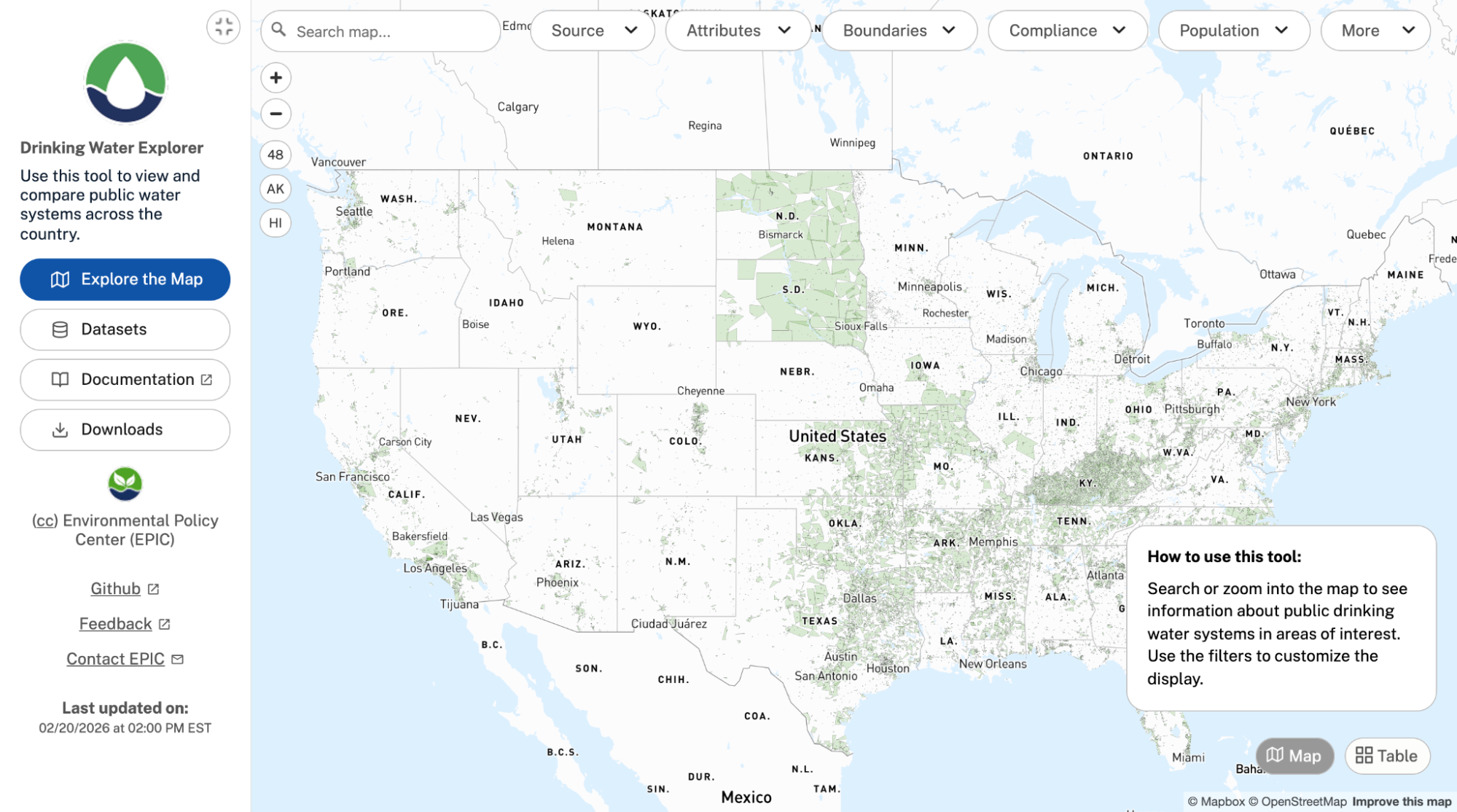
Access the tool via our website
From Texas to the Nation
This work started in 2024 with a pilot data pipeline and application in Texas — a state with enormous demand for water infrastructure investment. That tool helped utilities, policymakers, and technical assistance providers answer questions that previously required juggling data from a half-dozen sources. The feedback was strong, but the most common feedback EPIC heard was: "I don't live in Texas."
So we decided to build it for everyone.
Over the past year, EPIC undertook a process of national discovery — learning from researchers, regulators, utilities, technical assistance providers, community organizations, and funders about the data they use, the questions they need to answer, and what features and functions they had on their wish lists. Then we built a transparent and durable data pipeline capable of delivering harmonized data, and a tool to put the information in people's hands.
The Data: 821 Variables, 30+ Datasets, One Unified Pipeline
The datasets are a product in their own right. Our data pipeline pulls from sources across three distinct yet interconnected domains:
Water systems — EPA's Safe Drinking Water Information System (SDWIS) contains information about disaggregated rule violations over 5 and 10 years, State Revolving Fund award history, EPA Service Area Boundaries, and drinking water advisories collected from 13 states (boil water, do-not-drink, and do-not-use orders — the largest publicly accessible inventory of its kind in the U.S.).
Communities served — Census demographics and 10-year change for 50+ variables are provided by data about annual median household income, estimated water rates, the CDC Social Vulnerability Index, and the Climate and Economic Justice Screening Tool (CEJST).
Environmental context — Information about well and intake watersheds, impaired waterways, underground storage tanks, facilities with Risk Management Plans, and NPDES permits — are all linked to the water systems drawing from those sources.
We investigated 821 variables and distilled them into approximately 130 well-documented fields available in the tool. Everything is summarized at the water system level using Public Water System ID (PWSID), meaning data from watersheds, census geographies, and tabular sources have all been harmonized to a common framework. EPIC used EPA's crosswalk and a mix of areal, household-weighted, and population-weighted interpolation methods to do this right — and provided documentation at every step.
The pipeline runs on Amazon Web Services (AWS) which automatically updates key datasets daily, quarterly, or annually. The tool itself updates on a quarterly basis, after datasets pass data quality checks and expert review. All of EPIC’s code is open source and available on our public GitHub repository.
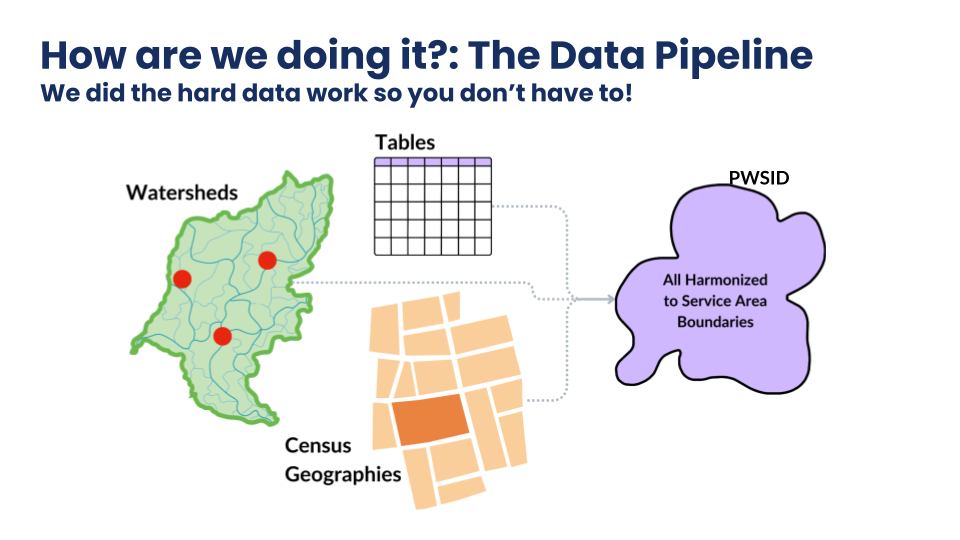
How the National Drinking Water Dataset spatially combines different sources
Built for Real Work
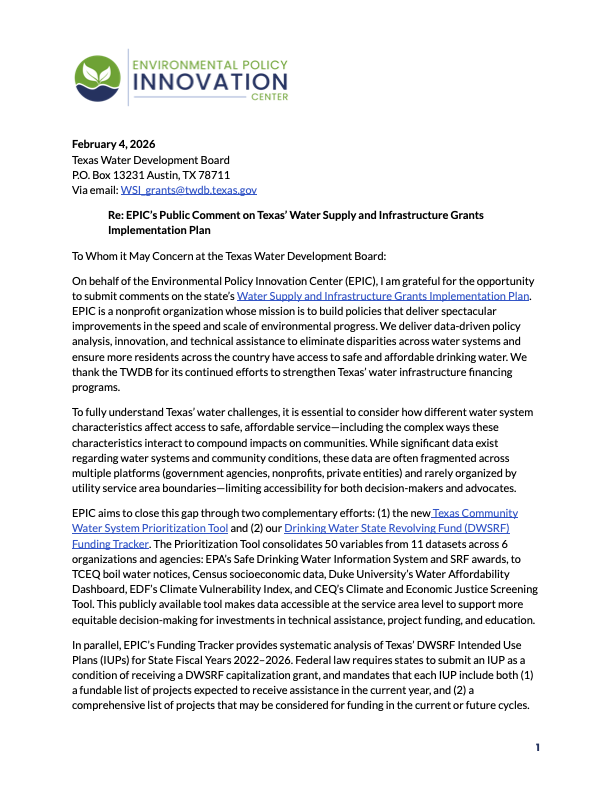
Snapshot of EPIC’s Public Comment using the National Drinking Water Dataset - Texas’s HB500 $1B investment in water infrastructure
The tool is designed for the full spectrum of people in the drinking water ecosystem — and EPIC expects that different people will use it differently. The dataset and tool are engines that can power all different kinds of vehicles.
For technical assistance providers, the tool eliminates the "too many tabs open" problem. Before engaging a community, EPIC’s Funding Navigator team used to piece together Census data, SRF records, compliance history, and more from separate sources. The tool puts all of that in one place, freeing up more time to spend actually support communities.
For policymakers, the tool enables more rigorous, data-grounded analysis. Using an earlier iteration of our national tool, EPIC submitted public comment on Texas SB500 — a $1 billion grant investment in water infrastructure. EPIC’s analysis showed that proposed funding allocations disproportionately favored large systems, while small and very small systems serve the greatest share of Texans. The Texas Water Development Board implemented our analysis - dedicating $42 million to systems serving under 1,000 people - and increasing project proposal caps.
For researchers and academics, the tool lowers the barrier to move from question to analysis. Research teams at ASU, Stanford, and UCLA have already been testing methods and generating insights with earlier itterations of the tool.
For regulators, the tool supports more equitable deployment of funds by making system performance, community characteristics, and funding history visible in one place.
What You Can Do With It
The tool's main features include an interactive map and data table with filters, dataset cards with documentation, and downloadable. Some example uses are
Locating all drinking water systems in a given state, filtered by size, ownership type, or compliance status
Identifying systems with open violations and climate vulnerability
Finding small systems serving low-income communities that haven't received SRF funding
Downloading filtered datasets for your own analysis
Linking directly to authoritative EPA compliance data for any system
The tool was developed in collaboration with the Center for Neighborhood Technology (CNT).
What We've Learned
This work is more ambitious than EPIC initially imagined. Scaling from Texas to all 50 states wasn't 50 times the work — it was a project to the 50th power. A few things have become clear along the way:
Iteration matters, and it has to happen in the open. EPIC knows that we won't get it all right the first time so we developed our the pipeline to be modular and open source so that making improvements is more efficient and community-driven.
Different people need different things. The drinking water space spans utility operators, community advocates, federal policymakers, and academics — all with different questions and different data needs. Walking the line between too much and too little complexity will be core to the project's success.
The dataset and tool are both products. EPIC built a data pipeline, not just a one-off dataset. When you turn on the tap here, we are hopeful that the data will flow in ways that enable meaningful research and policy making.
What's Next
EPIC is now moving into the design and development stage for Version 1.1 this spring and summer, driven by feedback from people like you. We're also gearing up to launch usability sessions, and group steering opportunities — we are creating dedicated spaces to engage practitioners, researchers, and advocates on what works now, and what to build next
Here's how you can get involved:
💻 Check it out! National Drinking Water Dataset + Explorer Tool
👋 Interested in collaborating? Sign up to get invited to events and sessions!
🎥 Want to learn more? View the release webinar recording and presentation.
EPIC built this for you, and we're continuing to build it with you. If you've found the work useful — or if you see what else is possible — we’d love to hear from you.