Coastal Resilience Practice Is Evolving Fast—Here's How Professionals Can Keep Up
Coastal resilience practice is evolving at breakneck speed. Parametric insurance pilots are launching. Benefits of ecosystem restoration and nature-based solutions are being quantified in new ways. Federal funding landscapes have shifted dramatically overnight. For professionals trying to stay current, it feels easy to fall behind. Events over the past year - from federal funding upheavals to rapid advancements in alternative financing models - have certainly made this true for me.
When I left my job as a Senior Policy Advisor at New York City’s Mayor’s Office of Resiliency, where I led work on extreme heat, resilient infrastructure, and climate health, my professional network in coastal climate resilience shrank. And though I knew people in specific agencies and organizations, my connections were regionally concentrated rather than connected to the broader national community. Innovations have been evolving faster than I could track through the occasional webinar or conference, and, as Resilience and Data Lead for Environmental Policy Innovation Center (EPIC), I was searching for a way to refresh my knowledge in restoration, nature-based solutions, and financing alternatives in the local climate resilience space.
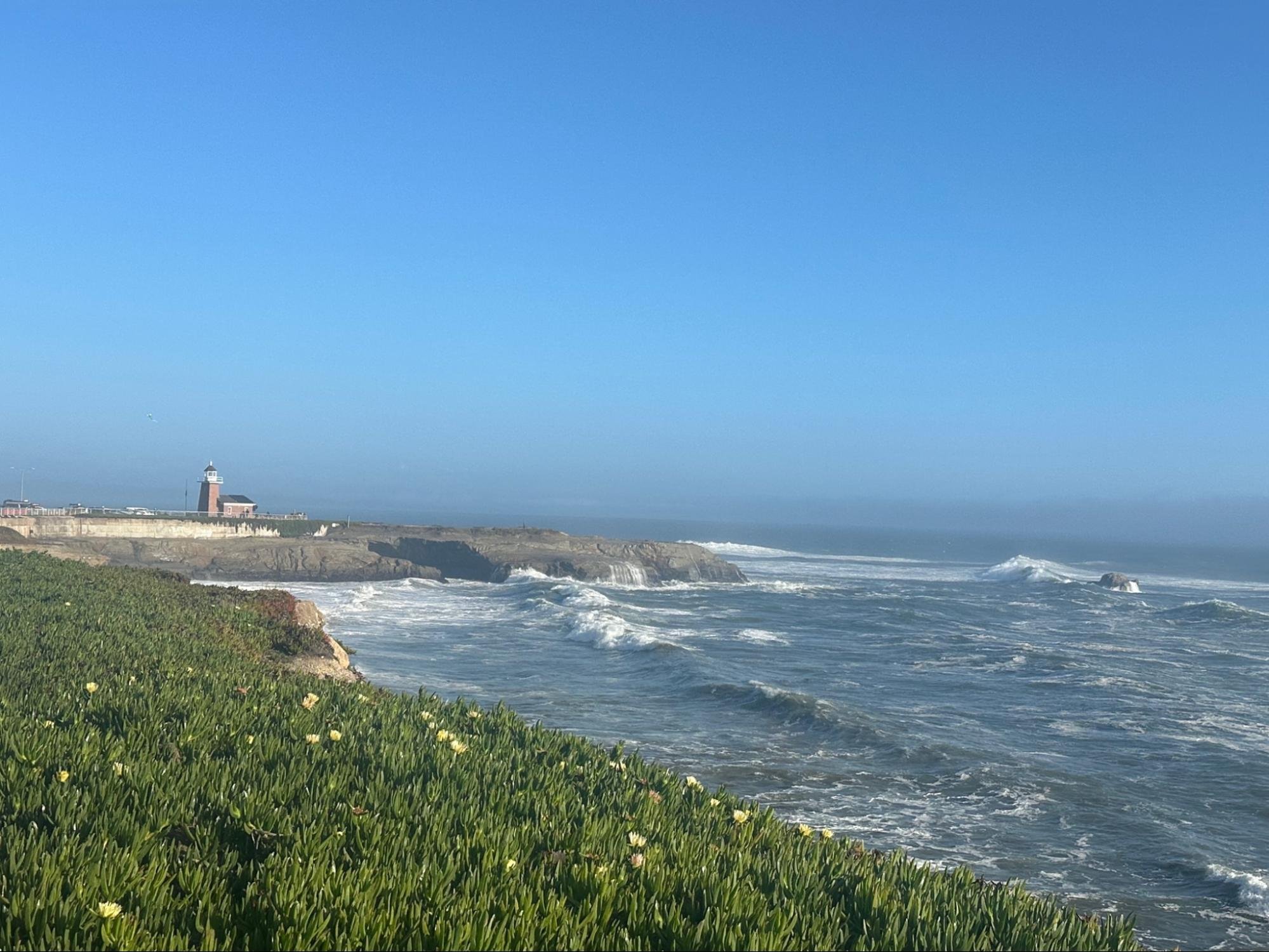
Santa Cruz Coastline, view of Lighthouse Point
The University of California Santa Cruz (UCSC) Professional Course in Coastal Climate Resilience seemed perfect for a few reasons: practitioner-led sessions, a cohort from diverse backgrounds, and an engaging structure that included real time presentations and in person conversations.
UCSC is a leader in coastal resilience education and research. Dr. Mike Beck, Director, UCSC Center of Coastal Climate Resilience, leads pioneering research that helps translate ecosystem benefits - from wetlands to coral reefs - into quantifiable risk reduction from flooding, storm surge, and more. UCSC faculty members are advancing technological innovation through the use of game engine technology to visualize fluctuations in coastal flood risk under different scenarios of mangrove cover, sea-level rise, and severe storms. These are just a few examples of the cutting-edge ideas and thought leadership that this program puts at participants' fingertips.
What’s Happening in Coastal Resilience
The 10-week course covered hot button topics like innovative finance, federal funding chaos, and community engagement – because all resilience is local.
Innovative Financing is Moving from Theory to Practice
The session brought together experts on parametric insurance from reinsurance company Guy Carpenter as well as blue carbon credits from Conservation International. The insurance experts walked us through the risk models being used in an active research project that shows mangrove protection reduces hurricane insurance premiums by 12% in the Philippines. The Director from Conservation International introduced us to Restoration Insurance and Financial Services Company (RISCO), a first-of-its-kind social enterprise that braids insurance, carbon credits, and revenue-based financing to fund coastal restoration work.
These types of financing structures have been challenging to implement in the U.S., but pilot programs are emerging that can light the path forward. Discussions around alternative funding sources are urgent and timely given the current federal funding uncertainty. Access to other sources of capital to implement resilience work is a challenge that needed to be solved yesterday.
Federal Funding Uncertainty Requires Strategic Adaptation
A former FEMA Branch Chief taught this session during an actual government shutdown. She used the chaos as a teaching moment, which I appreciated.
Uncertain times can be used strategically. Now is the time to focus on planning, equitable community engagement, preliminary design, and permitting, and lining up shovel-ready projects. Tackling the pre-work now ensures communities are prepared to secure big grants when funding becomes available again. For example, we could consider framing our work as “economic development” or “public safety” depending on the audience, even if resilience is still the goal.
But even the best funding strategies fall apart without community support.
Meaningful Engagement Remains Non-Negotiable
A director from the Water Institute walked us through several examples of well-intentioned projects that failed due to lack of community engagement – Detroit residents rejecting free trees because no one asked them first what they needed most. Houston invested in park connectivity when what the community really wanted was lighting and working bathrooms.
In stark contrast to those troubled projects, a Santa Cruz County Director reflected on his successful five-year effort to pass coastal litter policy. He provided a helpful overview of the steps he took to engage diverse communities whose support was needed to reach success. This included details on how he identified and prioritized different levels of engagement, implemented approaches that built trust, and eventually brought together a broad and diverse coalition.
Five years may seem like a long time to spend on engagement, but for policy advocacy it's a realistic timeline. Whether it’s policy or projects, the lesson remains the same: shortcuts on engagement lead to opposition, delays, or failure, and too often all three. If we are truly committed to speeding and scaling resilience work, we need to take the time to build trusting relationships and effective pathways for community input upfront so projects move forward without the roadblocks that sink poorly-engaged efforts.
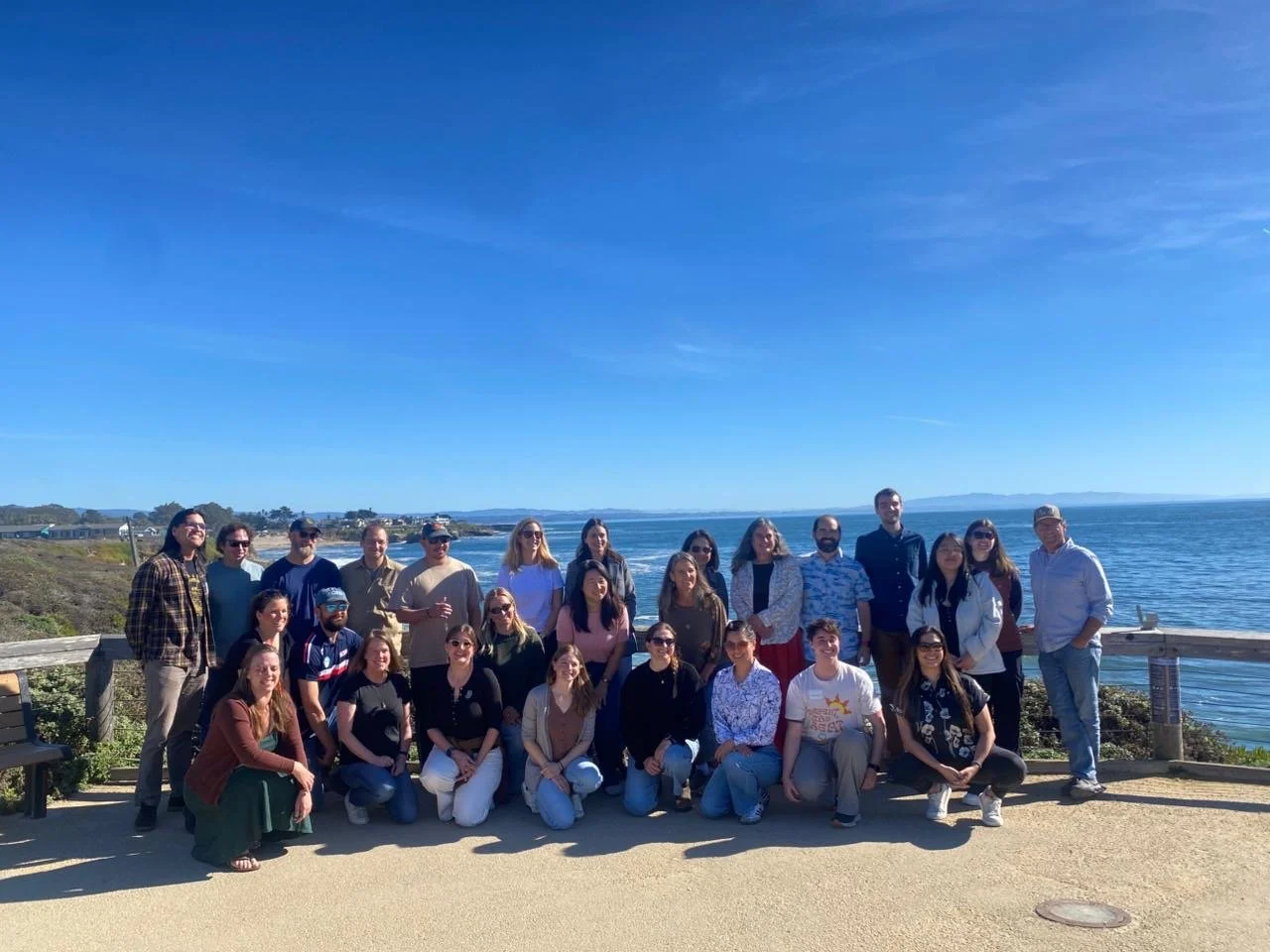
Group Picture, Fall 2025 Co-Hort of the UCSC Coastal Climate Resilience Professional Development Program, photo credit: UCSC
The 10-week course ended with a 3-day in-person workshop at UCSC Seymour Marine Discovery Center. The location was stunning; we had a full view of the coast while we worked. And work we did! We listened and engaged in panel discussions with practitioners covering diverse approaches to coastal resilience topics. One local elected official detailed his approach to cultivating community buy-in for an active resilience planning process that involves relocating critical infrastructure like roads. A chief resilience officer shared strategies for advising local cities and municipalities on how to integrate extreme weather risks into capital construction pipelines and revise local policies to accelerate project implementation. Our group also experimented with virtual reality and its role in disaster risk engagement, and then worked in small groups on real coastal challenges that participants brought from their own work.
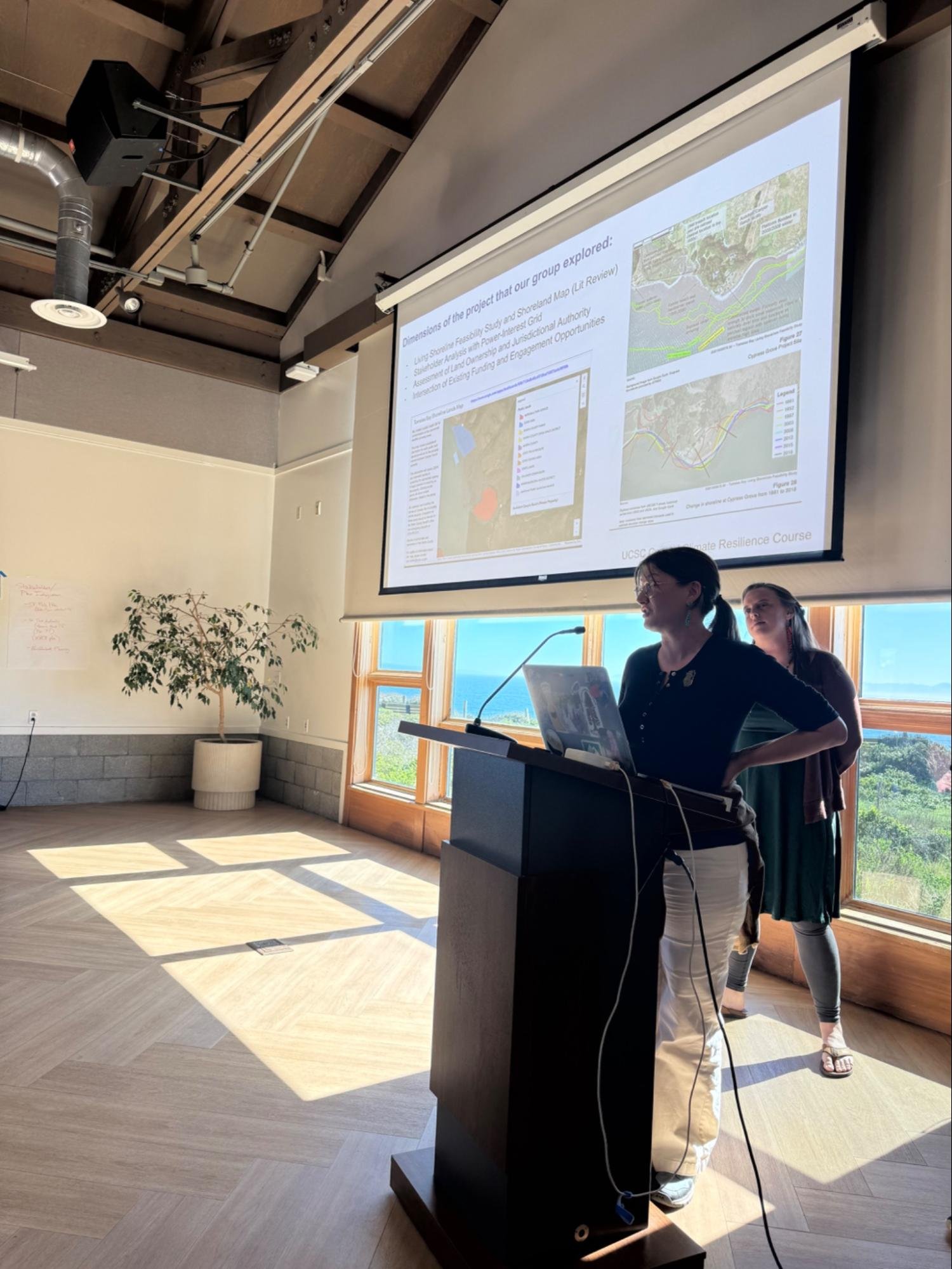
Presenting Aspects of a Case Study Focused on Nature Based Solutions at Cypress Grove and Tomales Bay, California, photo credit: UCSC
My team worked on a case study tackling the complex challenge of developing a stakeholder engagement strategy to accelerate adoption of nature-based solutions at Cypress Grove in Tomales Bay. For two days we poured over large satellite images of the site to map and analyze different dimensions of work - from overlapping government jurisdictions, to changing land use and shifts in ecological systems, to threats from precipitation, wave intensity, erosion, and sea level rise. The teaching team and guest lecturers were on hand throughout the working sessions to guide our discussions, and we used an expertly distilled library of reference materials and guidance documents to structure some recommendations to a local NGO looking to move forward with engagement around natural coastal protection for the area. This provided us a hands-on way to apply what we'd learned through the course to real coastal challenges communities are actively facing.
Ten weeks later, I am now actively discussing collaboration and partnership with people I met through the program whose expertise aligns with some of EPIC’s coastal resilience policy interests. At EPIC we focus on removing structure barriers that prevent restoration from happening at scale - such as complex permitting that consumes project budgets, financing structures mismatched to restoration timelines, and limited technical capacity at the state and local levels. For example, many of the connections and insights from this program are directly informing our emerging research agenda on potential mechanisms for financing landscape-scale restoration, including the feasibility of emerging catastrophe insurance approaches. And the benefits of my attending the program continue to grow.
Learn more about the UCSC Coastal Climate Resilience Professional Course.